Ask most HVAC owners what they need to grow and the answer comes fast.
"More leads."
It sounds right. It feels obvious. And it is almost always the wrong answer.
Not because leads don't matter. They do. But because "more leads" is not a strategy. It is a reaction. And when it becomes the default goal, it hides the real problems sitting underneath your revenue.
The question is never 'how many leads do I need.'
The question is 'how many of the leads I already get are turning into booked jobs.'
The Lead Obsession Is Hiding an Operations Problem
Here is what we see constantly in HVAC businesses. An owner looks at a slow month and immediately blames lead volume. So they increase ad spend, sign up for another lead gen service, or throw money at a new marketing channel.
But that is not the real issue.
The real issue is usually somewhere between the phone ringing and a tech showing up at the door. Calls go unanswered. Leads sit for hours before anyone follows up. The CSR doesn't book the appointment. The estimate gets sent but nobody closes.
We wrote about this pattern in detail in why most HVAC marketing fails before it starts. The failure point is almost never the marketing itself.
The HVAC industry is not short on demand. According to the U.S. Energy Information Administration's Residential Energy Consumption Survey, heating and cooling account for roughly 52% of a household's total energy consumption.
Homeowners need these systems. They need service. The demand exists.
The question is whether your business can actually capture and convert it.
Think about it.
If you are spending $5,000 a month on marketing and a significant portion of those calls go to voicemail, you are not underspending on leads. You are leaking the ones you already paid for.
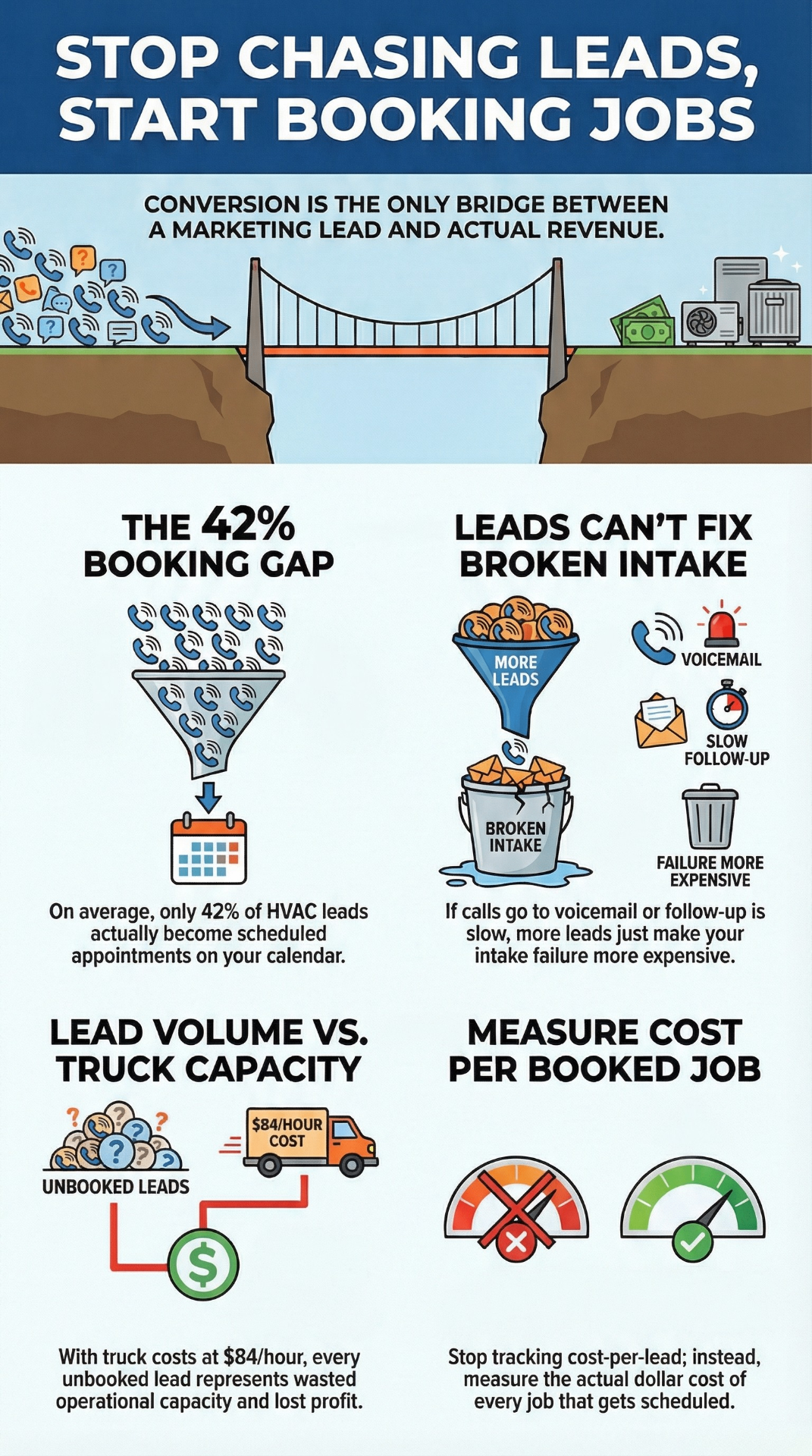
More leads don't fix a broken intake process.
They just make it more expensive.
A Lead Is Not a Booked Job. Stop Treating Them the Same.
This is where the math falls apart for most HVAC companies.
A lead is someone who expressed interest. They filled out a form, called your number, or clicked an ad.
That is it.
They have not committed to anything. They have not been qualified. They are not on your schedule.
A booked job is a person with a confirmed appointment on your calendar, matched to an available tech, with a real service need. That is the unit that produces revenue. Not the lead.
Let's break this down.
Industry data consistently shows the average booking rate for trade businesses sits around 42%.
That means for every 100 leads your marketing brings in, roughly 42 actually become scheduled appointments.
The rest either don't answer when you call back, were not qualified, got a faster response from a competitor, or simply changed their mind.
And that 42% is the average. Plenty of companies sit well below that, especially during peak season when call volume spikes and staff gets overwhelmed.
This is why we always start with booking rate before looking at lead volume. It tells you more about the health of your business than any ad dashboard ever will.
If your booking rate is 30%, you don't need more leads.
You need a better process between the phone ringing and the job getting scheduled.
Reverse-Engineer the Number from Your Revenue Goal
Most HVAC companies set revenue goals forward.
They pick a number, then figure out how to get there.
That is fine.
But very few work the math backward to see what the number actually demands from their operations.
Here's what we've seen.
Let's say your revenue target is $1.2 million for the year. That is $100,000 per month.
Now work backward.
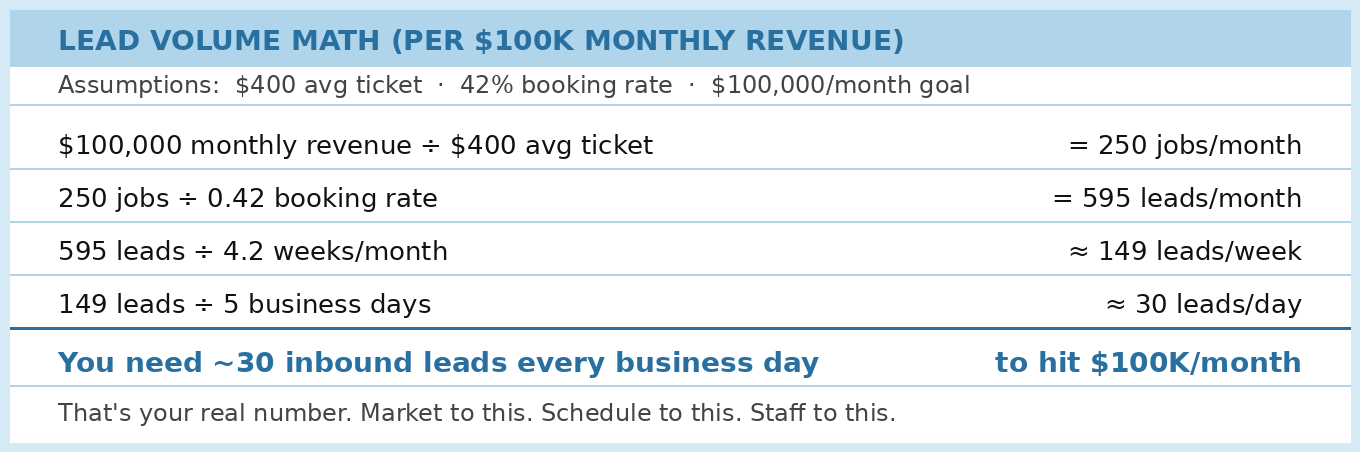
Now this is where it gets interesting.
Can your team actually handle 30 leads a day?
Do you have enough CSRs to answer those calls?
Do you have enough techs to run those jobs?
Is your dispatch system built to schedule that volume efficiently?
If you have not done this exercise before, our guide on how to calculate your HVAC team's true weekly capacity walks through the exact framework.
If the answer is no to any of those, then chasing 595 leads a month is a waste of money.
You will pay for leads you cannot convert, burn marketing budget on volume your operations cannot absorb, and end up frustrated that your investment is not producing results.
This is exactly what ACCA's 2025 financial analysis on the cost of rolling a truck flagged.
With the fully loaded cost sitting around $84 per hour per truck, including wages, benefits, vehicle expenses, insurance, and non-billable drive time, every lead that does not convert into a dispatched job is not just a missed opportunity.
It is wasted capacity.
Revenue goals are meaningless without the operational math to back them up. Leads are the input. Booked calendars are the output. Most companies only measure the input.
Why 'More Leads' Is Almost Always the Wrong Goal
The HVAC industry has a lead addiction. And the entire marketing ecosystem feeds it.
Lead gen companies sell on volume. Ad platforms optimize for clicks. Agencies report on impressions and form fills. Everyone in the chain is incentivized to deliver more, regardless of whether those leads ever become booked jobs.
And this is where most HVAC companies get it wrong.
They judge their marketing by how many leads it produces instead of how many jobs it books. Those are not the same thing. And confusing them is one of the most expensive mistakes in the industry.
The ACCA Contractor of the Future Study surveyed over 1,000 contractors and found that those allocating at least 12% of revenue toward marketing and advertising achieve net profits of 9%, compared to just 5% for those spending less.
But here is the detail that matters: the higher-performing contractors were not simply buying more leads.
They were investing in systems, software, and processes that converted leads at a higher rate.
The money went to field service management tools, flat rate pricing, and financing options that improved close rates by 11%.
Here's the thing.
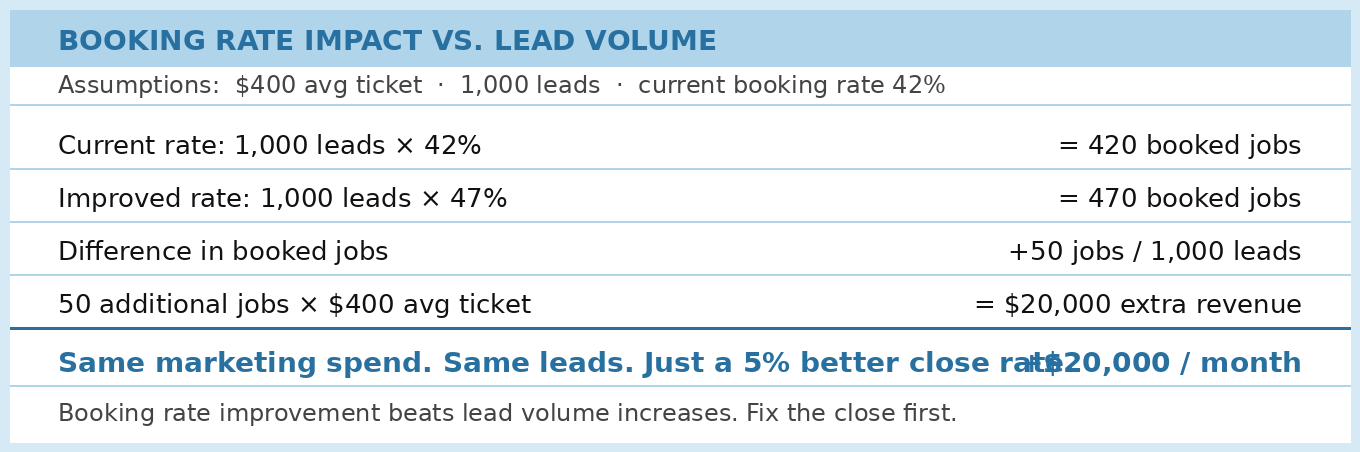
That is not from buying more leads. That is from converting the ones you already have.
What You Should Be Measuring Instead
If "more leads" is the wrong goal, what is the right one?
Let's be honest.
The answer is not one number. It is a set of connected metrics that tell you whether your marketing is actually producing booked revenue, or just activity.
Booking rate. What percentage of leads become scheduled jobs? If this number is below 40%, fix your intake process before spending another dollar on marketing.
Cost per booked job. Not cost per lead. Cost per job that actually got scheduled and completed. This is your real marketing cost, and it includes every lead that did not convert.
Revenue per lead. Take your total revenue and divide by total leads. This tells you the actual dollar value each lead produces after booking rates, average tickets, and close rates are factored in.
Capacity utilization. How full is your schedule? If your techs are running three jobs a day when the benchmark is four to five, you have a dispatch or routing problem, not a lead problem.
According to the Bureau of Labor Statistics Occupational Outlook Handbook, HVAC technician employment is projected to grow 8% from 2024 to 2034, significantly faster than the average for all occupations. About 40,100 openings are projected each year.
The labor market is tightening. You cannot afford to waste leads when finding and keeping good techs is getting harder every year.
Here's what we've seen.
The HVAC companies that grow steadily are not the ones spending the most on leads.
They are the ones who built systems that convert leads at a higher rate, schedule jobs more efficiently, and dispatch techs with less wasted time.
Their marketing spend is lower per booked job because their operations are not leaking revenue between the first call and the completed service.
That is the difference between a lead strategy and a system. A lead strategy buys inputs. A system produces outputs.
If you want to understand how that system should actually be structured from demand generation to a dispatched tech, read how HVAC marketing actually works.
And with ENERGY STAR reporting that the average household spends about $1,900 a year on energy bills, with nearly half going to heating and cooling, the demand for HVAC service is not going away.
The homeowners are there. The money is there.
The only question is whether your business is set up to capture it efficiently.
The goal is not more leads.
The goal is controlled demand. Enough to keep your teams fully scheduled without overwhelming your operations.
What to Do With This Information
Start with your revenue goal and work backward. Know exactly how many booked jobs you need per month, per week, per day.
Calculate your current booking rate. If you do not know this number, that is the first problem to solve. Your phone system, CRM, or dispatch software should be able to tell you.
Compare your required lead volume against your actual capacity. Can your CSRs handle it? Can your techs run that many jobs? If not, spending more on leads is not going to help.
Fix the leaks before adding more water. If leads are going unanswered, if follow-up is slow, if your booking rate is under 40%, those are the problems that deserve your budget first.
Measure cost per booked job, not cost per lead. This single shift in how you evaluate marketing will change every decision you make about where to spend and what to cut.
The HVAC companies that win long term are not the ones buying the most leads. They are the ones who need the fewest leads to hit their revenue goals. Because their system, from the first call to the dispatched tech, actually works.