Most HVAC owners do not distrust marketing because they misunderstand it.
They distrust it because they have experienced it without structure.
They have invested in tactics before understanding the roadmap.
They have seen reports without knowing what improved.
They have generated leads without increasing scheduled revenue.
Marketing feels confusing and risky for a reason.
The problem is not marketing.
The problem is how it is usually done.
When marketing is executed as isolated services, results feel inconsistent. When it is applied as a structured system aligned to how HVAC companies operate, it produces predictable demand, stronger close performance, and fully scheduled teams.
Marketing Must Respect HVAC Constraints
HVAC companies operate inside real constraints:
- Technician capacity
- Service mix margins
- Seasonal swings
- Close rates
- Cash flow timing
- Homeowner hesitation around high-ticket purchases
The U.S. Bureau of Labor Statistics projects continued demand for HVAC technicians, reinforcing the reality that technician capacity is a structural constraint, not a short-term issue.
Marketing that ignores these realities creates volatility. It increases activity without increasing revenue. It amplifies weak follow-up processes. It exposes undertrained sales conversations.
Many inbound leads are not fully convinced buyers. They are cautious. They are evaluating financial risk. They want reassurance that replacing a system is a smart long-term decision.
Growth stabilizes only when marketing, operations, and close performance align.
Marketing that ignores capacity, margins, and close performance does not create growth. It creates pressure.
If you want to understand why that happens at a structural level, Why Most HVAC Marketing Fails Before It Starts breaks down the exact patterns we see repeated across companies that can't seem to get traction no matter how much they invest.
The Real Path From Market to Scheduled Job
Most marketing conversations start with leads.
Leads are the middle of the system.
Leads do not create revenue. Scheduled jobs do.
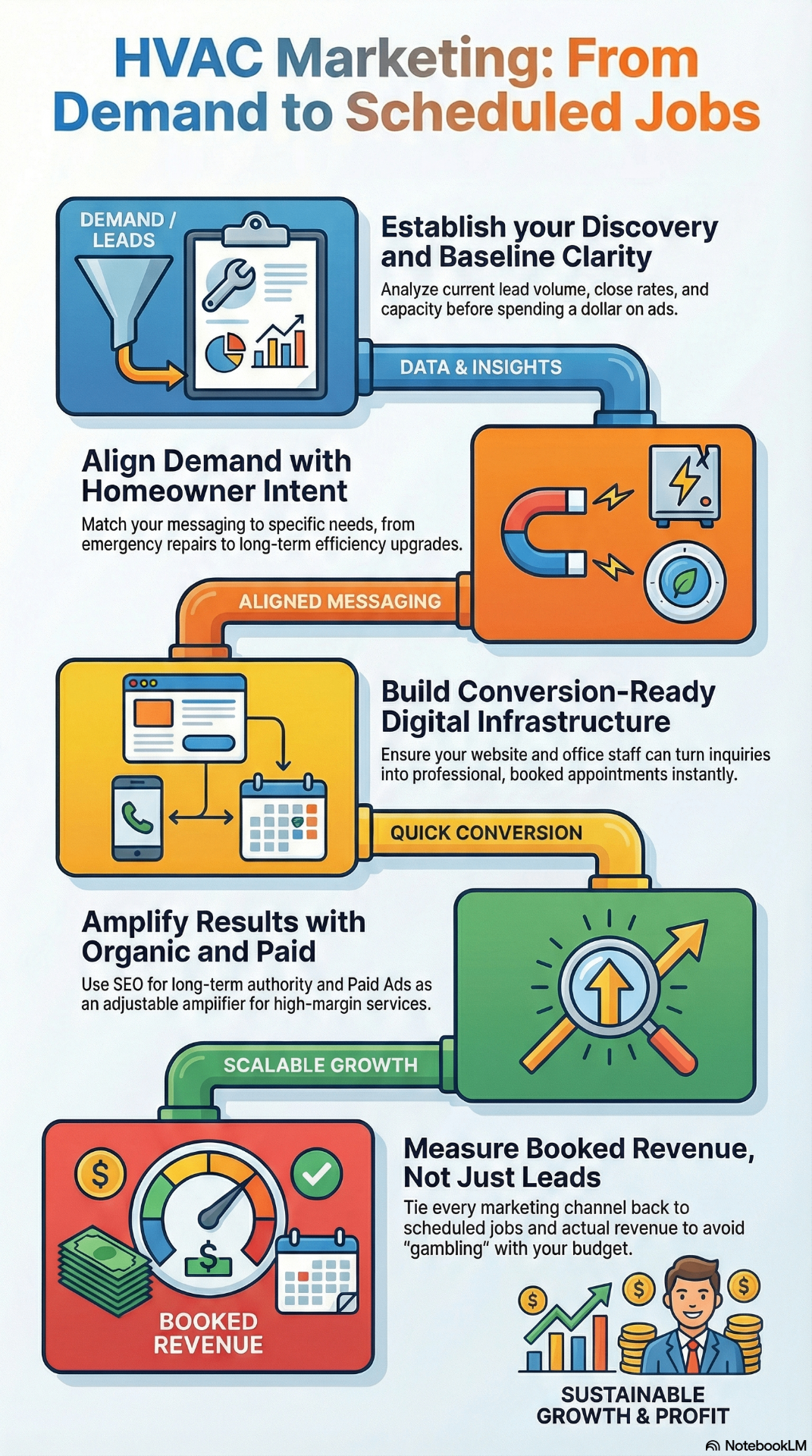
The full system looks like this:
- Discovery and baseline clarity
- Demand and intent alignment
- Conversion infrastructure
- Organic authority
- Paid amplification
- Reputation and trust reinforcement
- Measurement and optimization
Each phase builds on the last. Skipping steps increases risk. Following sequence reduces uncertainty.
Phase 1: Discovery and Baseline Clarity
Before execution begins, clarity must exist.
This is where HVAC growth strategy and planning happens. Baseline assessment, demand planning, service mix prioritization, and seasonal forecasting form the foundation of everything that follows.
This phase establishes:
- Current lead volume by service
- Close rates by service type
- Average ticket values
- Capacity limitations
- Seasonal revenue patterns
- Existing digital performance
If you haven't done that math yet, How to Calculate Your HVAC Team's True Weekly Capacity walks through it step by step. You can't set a marketing target if you don't know your ceiling.
Without a defined baseline, marketing becomes reactive. With strategic clarity, growth becomes intentional.
Outcome of This Phase
Revenue growth begins with focus. By identifying high-margin services and operational bottlenecks, HVAC companies allocate marketing resources where they drive the strongest return. Baseline clarity prevents waste by avoiding volume in low-profit areas. It creates measurable targets so improvements in booked jobs and revenue can be tracked accurately over time. Strategy protects margin before scale begins.
Phase 2: Demand and Intent Alignment
Not all HVAC demand behaves the same.
- Emergency repair demand is urgency-driven.
- Replacement demand is research-driven.
- Maintenance demand is relationship-driven.
- Efficiency upgrades are education-driven.
Demand alignment is executed through structured HVAC SEO, Local SEO, Google Business Profile optimization, citation consistency, service-area targeting, entity optimization, and AI-friendly content architecture.
When visibility aligns with homeowner intent, marketing attracts qualified conversations instead of just higher volume.
Chasing volume beyond that point doesn't grow revenue. It creates chaos. How Many Leads Does an HVAC Company Actually Need? gives you a clear framework for arriving at that number so your demand and your delivery stay aligned.
According to the U.S. Energy Information Administration, heating and cooling account for the largest share of energy use in American homes, which is why replacement decisions often involve cost comparisons and long-term efficiency considerations.
Many inbound leads are hesitant. They are comparing bids. They are weighing cost against long-term value. Demand alignment ensures messaging educates and reassures before the call ever happens.
Not every lead arrives convinced. Many arrive uncertain. Marketing must reduce hesitation before the first conversation even begins.
Outcome of This Phase
Revenue quality improves when marketing reaches homeowners with clear purchase intent. Higher-intent inquiries produce stronger close rates and fewer wasted estimates. Service mix becomes healthier because marketing attracts profitable work rather than just urgent breakdowns. Organic visibility builds a steady pipeline that reduces dependence on seasonal spikes and stabilizes monthly revenue.
Phase 3: Conversion Infrastructure
Visibility without conversion wastes budget.
Conversion infrastructure is powered by structured HVAC website design and optimization. Service and location page architecture, mobile usability, speed performance, accessibility, and call-path clarity determine whether traffic becomes booked work.
Conversion extends beyond the website. Calls must be answered promptly. Office teams must communicate clearly. Appointments must be scheduled professionally. Estimates must be presented with confidence and clarity.
If traffic increases but response systems are weak, close rates decline.
If you are not sure where the breakdown is happening, Why Your HVAC Website Isn't Converting walks through the most common reasons traffic shows up but never turns into a call.
Outcome of This Phase
Effective conversion infrastructure increases the percentage of visitors who become real inquiries. Faster response and clearer communication improve booking ratios without increasing traffic. Close performance strengthens because homeowners enter conversations with greater confidence. Revenue rises because more existing demand turns into scheduled work.
Phase 4: Organic Authority
Durable growth requires compounding visibility.
Organic authority is built through topical depth, strategic internal linking, technical SEO foundations, consistent business data, and structured entity signals that reinforce expertise across traditional and AI-driven search environments.
This is not about short-term ranking tricks. It is about sustained relevance.
Google's Search Central documentation emphasizes the importance of helpful, people-first content when evaluating site quality and authority.
Outcome of This Phase
Organic authority lowers long-term customer acquisition cost. As rankings stabilize and visibility expands, inbound demand becomes more predictable. Dependence on paid advertising decreases over time. Revenue growth becomes sustainable because visibility compounds rather than resetting each quarter.
Phase 5: Paid Amplification
Paid advertising is an amplifier.
When aligned with operational readiness, Google Search Ads and Local Services Ads can increase high-margin service inquiries, stabilize slow seasons, and maintain technician utilization.
Paid traffic also exposes weaknesses. If close rates are low or follow-up is inconsistent, increased volume increases waste.
Campaigns must align with service profitability and booking performance.
Outcome of This Phase
Strategic paid amplification allows HVAC companies to control revenue acceleration. Lead flow can be increased deliberately to match technician availability. Seasonal dips can be softened through targeted campaigns. Revenue becomes adjustable instead of reactive, supporting consistent scheduling and margin protection.
Phase 6: Reputation and Trust Reinforcement
Trust directly influences close rate in HVAC.
Reputation management systems ensure completed jobs become visible proof of reliability through structured review generation, testimonial collection, review deployment, and ongoing monitoring.
Air Conditioning Contractors of America (ACCA) sets nationally recognized standards for HVAC system design and contractor professionalism, and homeowners increasingly look for signals that a company operates at that level of rigor.
Stronger trust reduces hesitation and improves booking confidence.
To see exactly what signals homeowners weigh most heavily, What Homeowners Actually Look for When Hiring an HVAC Company breaks down the decision from their side of the table.
Outcome of This Phase
Higher review volume and stronger reputation signals improve close rates without increasing lead volume. Average ticket often increases because homeowners feel secure choosing long-term solutions. Referral volume grows, lowering acquisition cost. Revenue becomes more efficient because existing demand converts at a higher rate.
Phase 7: Measurement and Optimization
Marketing without measurement feels like gambling.
Marketing analytics and reporting tie every channel back to scheduled jobs and revenue through lead source tracking, service-level reporting, conversion analysis, cost per booked job evaluation, and demand trend monitoring.
Dashboards should be understandable. Metrics should guide decisions.
Outcome of This Phase
Data-driven optimization increases revenue efficiency. Marketing spend shifts toward higher-performing services and channels. Underperforming areas are corrected before they drain budget. Over time, cost per booked job decreases while total booked revenue increases. Growth becomes repeatable and controllable.
Where HVAC Companies Typically Fall Short
Most breakdowns happen between phases.
One of the biggest failures? Service vs install, marketing like a service company when you're built for installs or vice versa. The mismatch creates bottlenecks, blown budgets, and operational chaos. Service vs install capacity determines your marketing strategy.
Common failures include:
- Generating demand without strengthening close performance
- Increasing traffic without improving response systems
- Scaling ads before conversion is stable
- Ignoring homeowner hesitation in sales conversations
- Measuring leads instead of booked revenue
Structure forces alignment across marketing, operations, and close performance.
What Success Actually Looks Like
When the full system works, marketing feels calm.
- Schedules are filled intentionally.
- Technician workload is balanced.
- Seasonality becomes manageable.
- Close rates improve steadily.
- Revenue becomes forecastable.
Operational improvements include consistently booked calendars, balanced service mix, higher revenue per lead, reduced reliance on emergency-only work, and improved technician utilization.
Financial improvements include lower acquisition cost over time, stronger margins, increased average ticket, and predictable monthly revenue.
There's a simple way to check whether you're actually ready. The HVAC Capacity Planning Checklist is a practical pre-spend audit. Go through it before you commit another dollar to ads, SEO, or any demand generation. If you can't check every box, more leads won't fix the problem. They'll accelerate it.
Marketing becomes infrastructure instead of uncertainty.
The Core Problem and the Real Solution
HVAC owners are not struggling because marketing does not work.
They are struggling because marketing is often applied without sequence, without alignment to operational constraints, and without integration into how leads are handled and closed.
That creates volatility. It creates distrust. It creates inconsistent revenue.
The solution is system execution.
When strategy establishes clarity, when demand aligns with homeowner intent, when conversion removes hesitation, when authority compounds visibility, when paid media respects capacity, when trust strengthens close rates, and when measurement guides optimization, marketing becomes predictable.
Predictable demand leads to scheduled jobs.
Scheduled jobs lead to stable revenue.
Stable revenue supports confident growth.
That is how HVAC marketing actually works.