If you haven't read the full framework, start here: How HVAC Marketing Actually Works. It maps the full demand to booked job system this article builds on.
The Real First Step in HVAC Marketing
Most HVAC companies start marketing with one goal:
"Get more leads."
That sounds reasonable.
It is incomplete.
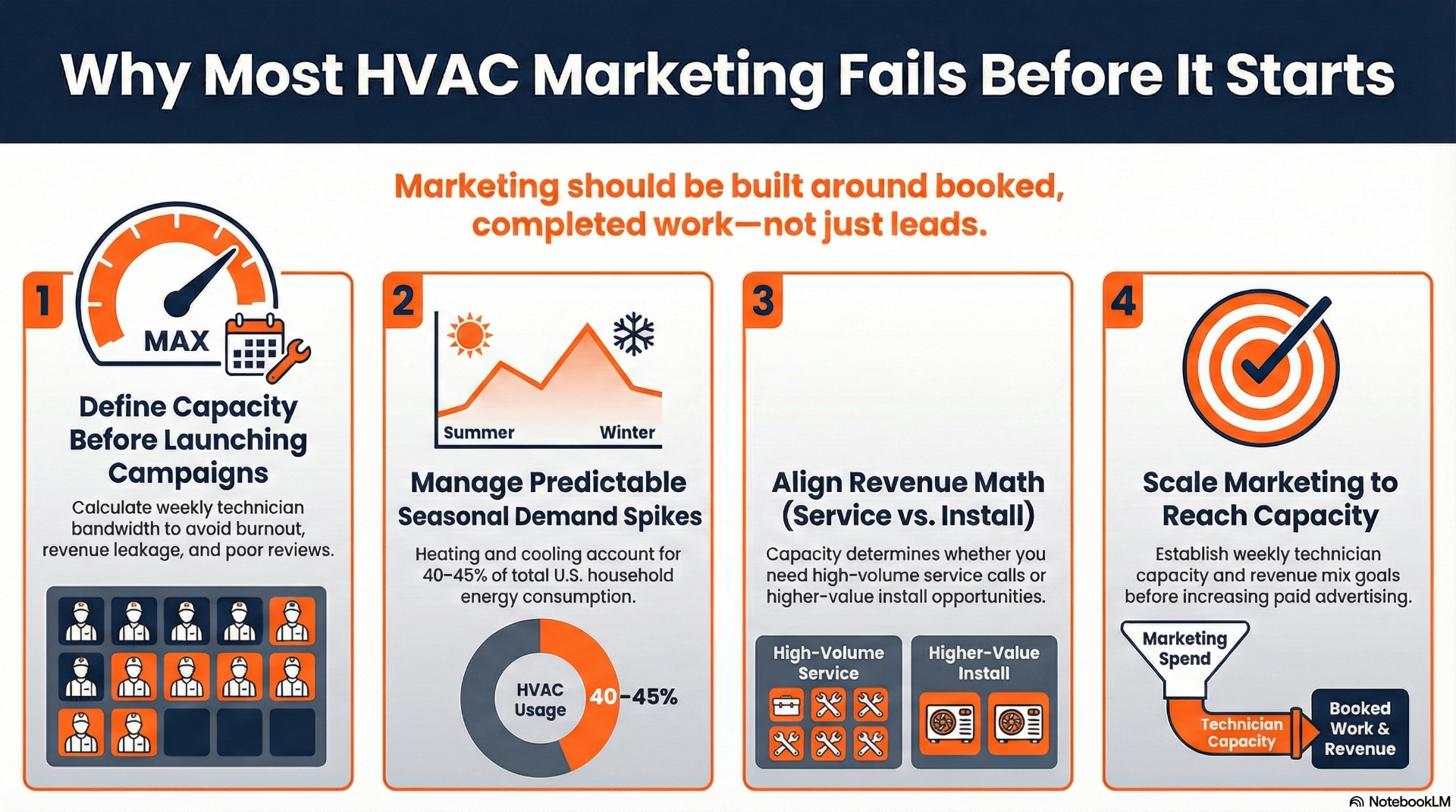
Marketing should not be built around leads. It should be built around booked, completed work your team can handle consistently.
That requires answering three operational questions:
- How many jobs can we realistically complete per week?
- What revenue mix are we targeting?
- Where does seasonality change the equation?
Without these answers, marketing creates chaos.
Most HVAC companies skip straight to tactics like Google Ads, SEO, Facebook. But marketing doesn't start with campaigns. It starts with understanding how HVAC marketing actually works from demand to scheduled jobs and why capacity comes before clicks.
HVAC Demand Is Not Random
The HVAC industry is structurally seasonal.
According to the U.S. Energy Information Administration, space heating and cooling account for roughly 40–45% of total household energy consumption in the United States.
Demand spikes are predictable:
- Summer cooling waves
- Winter heating failures
- Shoulder-season slowdowns
At the same time, the U.S. Bureau of Labor Statistics projects steady employment demand for HVAC technicians over the next decade.
Demand continues. Labor remains constrained.
Marketing must operate inside those realities.
1. Capacity Before Campaigns
If you have:
- 4 technicians
- 3 billable calls per day each
- 5 days per week
That equals 60 service slots weekly.
If marketing produces 95 viable calls, your team cannot absorb them.
These aren't assumptions, they're calculations. Before you touch a marketing budget, you need a real number. Here's how to calculate your team's true weekly capacity so you're not guessing.
Most operators don't know that number. Here's how to figure out exactly how many leads your company actually needs based on your current capacity.
What happens?
- Longer wait times
- Lower review scores
- CSR stress
- Technician burnout
- Revenue leakage
According to ACCA (Air Conditioning Contractors of America), workforce limitations remain one of the industry's largest operational constraints.
Marketing that ignores technician bandwidth increases strain.
That is not growth.
2. Revenue Math: Service vs Install
Not all booked work carries equal revenue weight.
The Air-Conditioning, Heating, and Refrigeration Institute tracks equipment shipment trends and replacement cycles.
Install cycles fluctuate with:
- Equipment age
- Housing stock
- Regulation changes
- Weather volatility
Service-heavy companies require steady booked calls. Install-focused companies require higher-value opportunities and longer sales cycles.
Service and install aren't just different revenue models. They require completely different marketing strategies. Here's how the split between service and install actually changes your marketing strategy.
Capacity determines what marketing mix makes sense.
Once you know your revenue per job and capacity limits, you can reverse engineer lead volume. Here's how to calculate exactly how many leads your HVAC company actually needs. No guessing, no over buying.
The Seasonality Multiplier
Seasonality changes budget decisions.
In peak cooling season:
- Lead volume increases
- Close rates rise
- Ad costs increase
Paid search costs spike when demand peaks. That's not a coincidence. Understanding how paid search and Local Services Ads work in HVAC changes how you budget across seasons.
In shoulder seasons:
- Demand softens
- Install competition increases
- Price sensitivity rises
Marketing budgets should flex with capacity and season.
Not panic.
Not guesswork.
What Happens When Marketing Outpaces Operations
We see this often.
A company scales paid advertising quickly.
Leads spike.
Booking lags.
Technicians overload.
Reviews drop.
Revenue volatility returns.
Marketing amplifies operational alignment.
Or misalignment.
The Correct Order of Operations
Before scaling marketing, define:
- Weekly technician capacity
- Target booked jobs per week
- Revenue mix goals
- Seasonal adjustments
- Booking rate benchmarks
Before anything else gets built, run through this capacity planning checklist. It tells you whether you're ready for marketing or whether you're about to waste the budget.
Then build marketing around those constraints.
This is infrastructure.
Marketing isn't a lever. It's a system. Here's what that infrastructure actually looks like when it's built to drive consistent demand.
Frequently Asked Questions
Should HVAC companies wait until they are fully staffed before marketing?
No.
But they must define realistic service bandwidth first.
Marketing should scale to capacity, not exceed it.
How This Connects to the Larger Framework
Market and capacity alignment is Phase 1 of a structured HVAC marketing system.
If you skip it, every phase after becomes reactive.
If you align demand with operations first, you create the conditions for:
- Consistently booked calendars
- Fully scheduled teams
- Predictable demand
- Stable revenue growth
Read the full framework here: How HVAC Marketing Actually Works. Complete breakdown of the 7 phase HVAC marketing system.
The Bottom Line
Marketing is not about traffic.
It is about matching demand to delivery.
If you want:
- Steady job flow
- Higher revenue per technician
- Reduced seasonal chaos
- Predictable booked work
Start with capacity.
Then build outward.
Getting the sequence right is exactly what HVAC growth strategy and planning is built for. Capacity first. Then the system to fill it.