You want more leads.
That makes sense. Every HVAC company does.
But here is what nobody talks about: most HVAC businesses that struggle with growth don't actually have a lead problem.
They have a capacity problem.
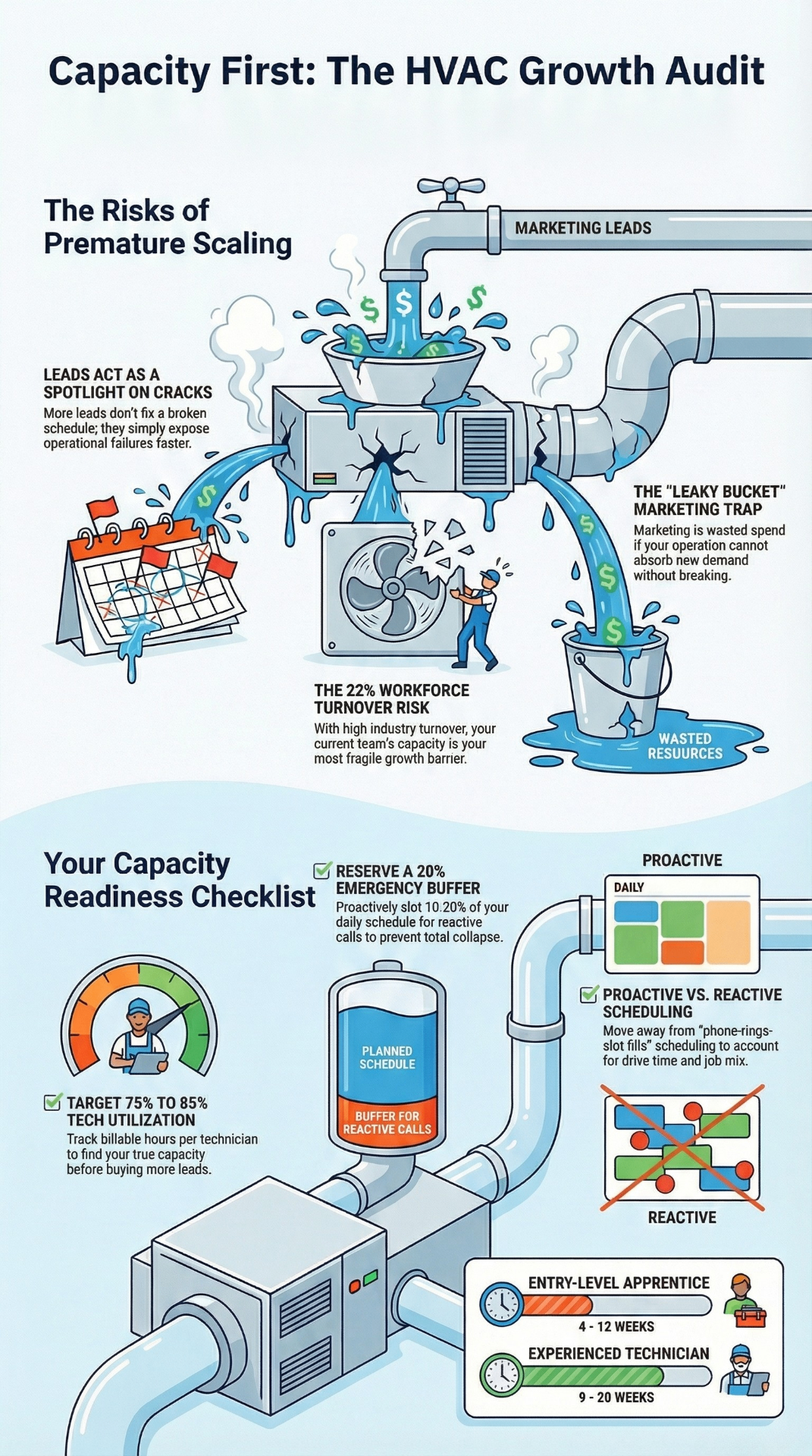
If your schedule can't absorb new demand without breaking, more marketing just exposes the cracks faster.
Think about it.
You run an ad campaign. Calls spike. Your dispatcher scrambles. Jobs overlap. Techs get double-booked. Customers wait. Reviews suffer.
And suddenly that money you spent on marketing didn't grow your business. It just stressed it.
The real question isn't "how do I get more leads?"
The real question is: can your operation handle what happens when those leads show up?
The Problem Nobody Wants to Admit
HVAC companies spend money on marketing before they know what their operation can actually handle. It happens all the time.
And the result is predictable.
Here's what we've seen.
The companies that stall aren't the ones lacking leads.
They are the ones that haven't done the math on their own operation.
They don't know how many jobs per day they can complete well.
They don't know their real technician utilization rate.
And they have no idea what happens to their schedule when five new calls come in on a Tuesday morning.
You don't need more leads.
You need to know how many you can actually serve.
This is where most HVAC companies get it wrong. They treat marketing like a faucet.
Turn it on, get more.
But if the bucket has holes in it, more water doesn't help. We wrote about this in detail in why most HVAC marketing fails before it starts.
The root cause is almost never the marketing itself. It is what is underneath it.
That is why we built this checklist. Not as a marketing tool. As an operations tool.
Because the smartest marketing investment you can make is understanding what your business can absorb before you ask for more.
1. Do You Actually Know Your Workforce Capacity?
This sounds basic. It isn't.
Most HVAC owners will tell you how many techs they have. Fewer can tell you how many billable hours those techs actually produce in a week.
Let's break this down.
The Bureau of Labor Statistics projects about 40,100 new HVAC openings per year through 2034, with employment growing 8%, significantly faster than the average across all occupations. That is demand growth the industry cannot fill fast enough.
Now this is where it gets interesting.
If the industry can't fill positions fast enough, your current team is your most valuable asset.
And according to ACCA's hiring data, HVAC service technicians face an annual turnover rate of 18 to 22%. That means you are losing and replacing nearly a fifth of your workforce every year.
If you don't know exactly how much capacity that team has, you are flying blind.
Checklist items:
- How many billable hours does each tech deliver per week? (Industry target: 75 to 85% utilization.)
- How many of those hours are reactive vs. scheduled proactively?
- What percentage of your daily schedule is reserved for emergency calls? (Best practice: 10 to 20% buffer.)
- Can you add volume without adding headcount, or are you already maxed out?
If you are not sure how to answer those questions, start with math. We put together a full breakdown of how to calculate your HVAC team's true weekly capacity. That is the foundation everything else sits on.
This is why we don't start with ads. We start with structure.
Knowing your total capacity is step one. Step two is understanding what type of capacity you have. Service vs install capacity requires completely different marketing strategies from budget allocation to channel selection to messaging.
Because if you can't answer these four questions, you shouldn't be spending on marketing yet.
2. Is Your Scheduling System Built for Growth, or Just Survival?
Scheduling looks easy until it isn't.
The difference between a company that handles growth and one that collapses under it almost always comes down to scheduling infrastructure.
Not marketing spend.
More leads don't fix a broken schedule.
They just expose it faster.
Here's the thing.
Most HVAC companies are still running reactive schedules. The phone rings, the dispatcher fills a slot. That works at low volume. It collapses at scale.
Growth requires proactive scheduling. It means knowing your job mix, your average completion time by job type, your drive time between service areas, and which techs are qualified for which calls.
Checklist items:
- Do you have a scheduling system, or are you running off spreadsheets and whiteboards?
- Can your dispatcher see tech availability, location, and workload in real time?
- Do you track average job duration by type (install, repair, maintenance)?
- Is there a protocol for slotting emergency calls without reshuffling the entire day?
- Are you measuring first-time fix rate?
In HVAC businesses, we consistently see this: marketing improves, but operations don't adjust with it.
The schedule breaks.
Techs get frustrated.
Customers wait longer.
And the owner thinks marketing failed, when actually the operation just couldn't keep up.
3. Do You Know Your Revenue Per Job and Your Real Cost to Serve?
Let's be honest.
You can be fully booked and still lose money.
Capacity planning isn't just about volume. It's about understanding which jobs are worth running and which ones are quietly draining you.
According to AHRI's guidance on proper equipment sizing, oversized systems cycle on and off too frequently, reducing efficiency and increasing wear.
The same principle applies to your business operations.
If your capacity isn't properly calibrated to your demand, you are losing money on every call.
Even the ones that look profitable.
Checklist items:
- What is your average revenue per job, broken down by type?
- What is your fully loaded cost per tech hour (including overhead, drive time, and callbacks)?
- Which job types generate the highest margin, and are you scheduling enough of them?
- Are you tracking callbacks and warranty returns as a cost against original job revenue?
The goal isn't more leads.
The goal is controlled demand.
Enough to keep teams fully scheduled without overwhelming operations.
If you haven't already, work through how many leads your HVAC company actually needs.
That number should be driven by your capacity, not the other way around.
4. Do You Have a Hiring Pipeline, or Just a Hiring Panic?
This one catches a lot of HVAC companies off guard.
You invest in marketing. It works. Demand goes up. And then you realize you need two more techs. Except hiring in this industry takes time.
Data from ACCA's recruiting partners shows it takes an average of 4 to 12 weeks to hire an entry-level apprentice and 9 to 20 weeks for an experienced service technician.
If you can't hire fast enough to match the demand you're generating, you're not growing. You're just falling behind on a bigger scale.
Think about it.
If your marketing strategy assumes you can add capacity on demand, you don't have a strategy.
You have hope.
Checklist items:
- How long does it take you to hire and onboard a new tech?
- Do you have relationships with trade schools or apprenticeship programs?
- Is there a plan for adding capacity before demand outpaces your team?
- What is your current annual turnover rate, and what is it costing you?
This is one of those areas where we see HVAC companies repeatedly caught flat-footed.
They invest in growth but never invest in the workforce infrastructure to support it.
Marketing accelerates the timeline.
You need a hiring plan that moves at the same speed.
5. Are Your Maintenance Agreements Working for You or Against You?
Maintenance agreements are supposed to create steady, predictable revenue. And they can. But only if they are structured with your capacity in mind.
Here's what we've seen.
Companies sell a high volume of maintenance plans during the offseason.
Great.
Then peak season hits and those plans eat up half the available schedule. Techs are booked solid doing tune-ups instead of running profitable install and repair calls.
The ENERGY STAR program recommends annual pre-season maintenance checkups for both heating and cooling systems. And EIA data shows that heating and cooling account for nearly half of all energy consumed in homes.
That is solid context for selling maintenance plans.
But for contractors, the real question is whether you have planned the capacity to deliver on all those agreements when the season turns.
Checklist items:
- How many active maintenance agreements do you have?
- What percentage of your peak-season capacity do they consume?
- Can you schedule maintenance proactively during shoulder seasons to protect peak capacity?
- Are your agreements priced to reflect true service cost, not just competitive pressure?
Maintenance agreements should stabilize your calendar.
If they are destabilizing it, that is a capacity design problem, not a sales problem. And it is something you want to fix before you add more volume on top of it.
How to Use This Checklist
This is not a one-time exercise. It is a quarterly discipline.
Before every marketing investment, before every ad campaign, before every decision to "scale up," run through these five areas:
- Workforce capacity.
- Scheduling systems.
- Revenue per job.
- Hiring pipeline.
- Maintenance agreement load.
If any of them are unclear, that is your first investment. Not marketing.
The companies that grow predictably are the ones that know their numbers before they ask for more demand.
This is the difference between growth and chaos. Both feel busy. Only one builds something that lasts.
Marketing doesn't fix operations.
But solid operations make marketing actually work. Once you have run this checklist and your numbers are solid, that is when marketing becomes powerful. That is when the system connects demand to scheduled jobs. We break down exactly how HVAC marketing actually works when it is built on that foundation.