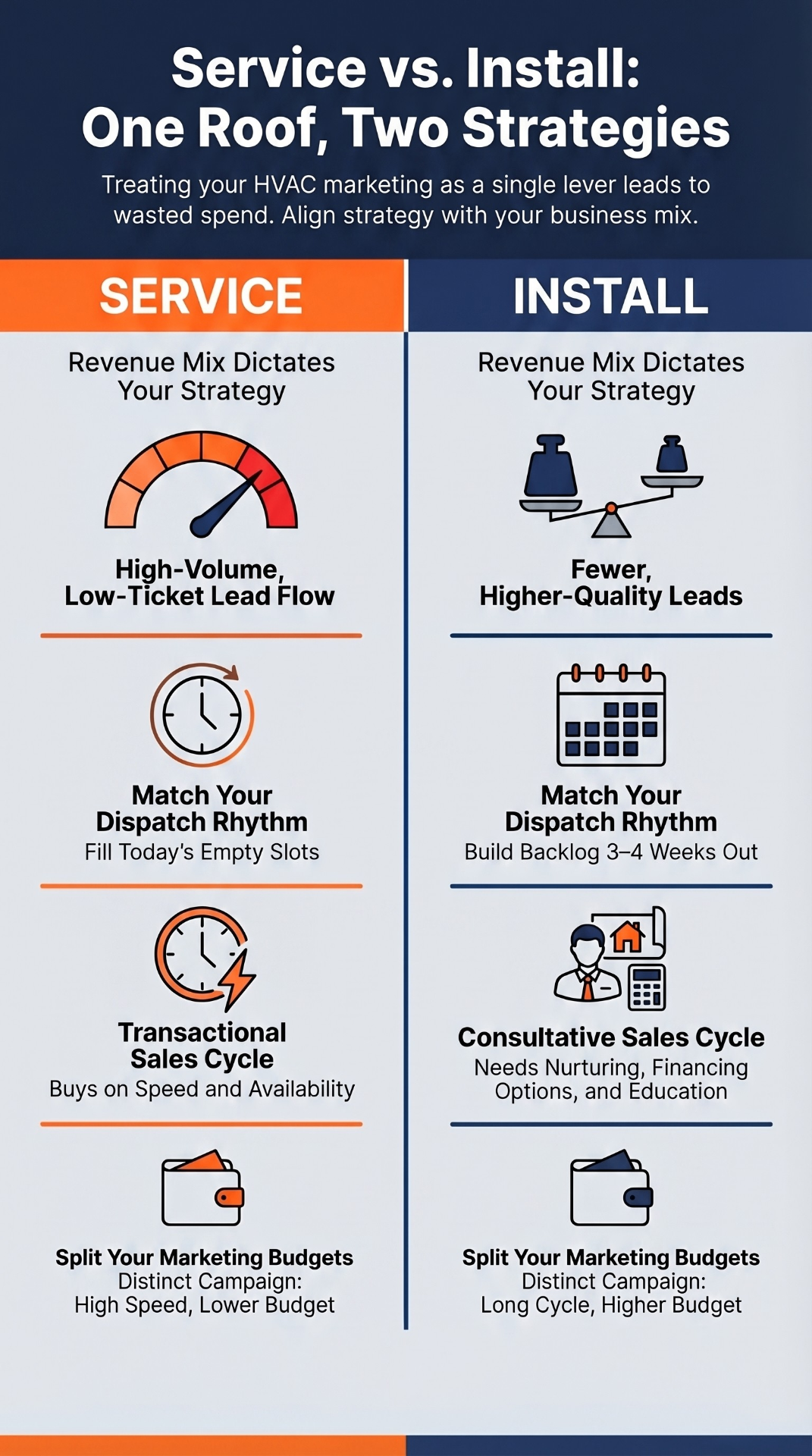
Most HVAC companies treat marketing like a single lever. More budget, more leads, more jobs.
Then they wonder why the same spend produces wildly different results from one month to the next.
Here's the thing.
The problem usually isn't the marketing. It's the assumption that one marketing strategy fits two completely different business models running under the same roof.
Service work and installation work are not the same business. They have different revenue profiles. Different dispatch models. Different sales timelines. And if you're marketing both the same way, you're probably wasting money on one side while starving the other.
You can't market service and install the same way and expect either one to perform.
Understanding how HVAC marketing actually works starts with acknowledging this split.
The path from demand to a scheduled job looks completely different depending on whether you're dispatching a service tech today or scheduling an install crew three weeks from now.
The Real Problem: One Strategy for Two Businesses
Walk into most HVAC companies and ask them what their marketing strategy is.
You'll hear things like Google Ads, SEO, maybe a mailer campaign.
Ask them whether that strategy changes based on whether they need more service calls or more install leads.
Blank stare.
And this is where most HVAC companies get it wrong.
They're running a single marketing playbook for a business that functionally operates as two different revenue engines.
The service side runs on speed, volume, and same-day dispatch.
The install side runs on consultations, proposals, and scheduled project timelines.
It's one of the core reasons most HVAC marketing fails before it starts.
The strategy isn't connected to how the business actually operates. It's connected to a vague idea that more leads solve everything.
More leads don't fix a broken strategy.
They just make the cracks easier to see.
Revenue Mix: Why Your Split Changes Everything
According to the U.S. Bureau of Labor Statistics, there are roughly 425,200 HVAC technician jobs in the U.S. as of 2024, with about 40,100 openings projected each year over the next decade.
The industry is growing.
But growth alone doesn't tell you how any individual company should be spending its marketing dollars.
What matters is where your revenue actually comes from.
Let's break this down.
A company that generates 70% of its revenue from service and maintenance is in a fundamentally different marketing position than one that pulls 70% from installations.
The service-heavy company needs consistent, high-volume lead flow for lower-ticket jobs.
The install-heavy company needs fewer, higher-quality leads with longer conversion windows.
ACCA's research on service agreement strategies shows that recurring service agreements now represent 55% of HVACR industry revenue.
That's not a side note.
That means for over half the industry, the backbone of revenue is repeat, scheduled work.
Not one-time big-ticket installs.
Think about it.
If your business is built on service agreements and maintenance plans, your marketing strategy should be designed to fill a steady pipeline of recurring work. Not to chase a handful of $10,000 install leads per month.
Your revenue mix should dictate your marketing approach.
Not the other way around.
We see this constantly in HVAC businesses.
Operators who are service heavy throwing money into install focused campaigns because the ticket size looks better.
Meanwhile, their service pipeline goes dry, and their techs sit idle three days a week.
This is exactly why knowing how many leads your HVAC company actually needs matters.
The number isn't one size that fits all.
It depends entirely on your revenue mix and what type of work your team is set up to handle.
Dispatch Differences: Speed vs. Scheduling
Service calls and install jobs don't just differ in price. They differ in urgency, routing, and how they hit your dispatch board.
A service call comes in hot.
The homeowner's AC is out.
It's 95 degrees.
They need someone today.
Your marketing for service work needs to generate leads that convert fast and fill same day or next day slots.
Now this is where it gets interesting.
Install work is the opposite rhythm. A homeowner starts researching a new system weeks or months before they buy. They get multiple quotes. They compare financing.
The sales cycle is long, and the marketing that drives install leads needs to account for that.
According to the EIA's Residential Energy Consumption Survey, space heating and air conditioning account for roughly 52% of a household's annual energy consumption. Homeowners know their HVAC system matters. But the decision to replace versus repair is rarely made in a single afternoon.
Your dispatch model reflects this.
Service teams run reactive schedules. The board fills and empties daily. Marketing needs to keep a steady stream of calls coming in to keep techs moving. If marketing stops, the board clears out within days.
Install crews run on booked out schedules. You're looking two, three, sometimes four weeks ahead. Marketing for installs needs to maintain a backlog, not fill today's gaps.
Service marketing fills today.
Install marketing fills next month.
Treat them the same and you'll starve one to feed the other.
This is why we don't start with ads.
We start with structure.
Before any dollar goes toward generating leads, you need to understand your team's true weekly capacity.
How many service calls can your techs handle per day?
How many installs can your crew complete per week?
Those numbers set the ceiling for what your marketing should produce.
Here's what we've seen.
Companies that don't separate their dispatch thinking end up with techs booked solid on low margin service calls while their install crew sits waiting for leads.
Or worse, they overload install leads and can't schedule jobs for six weeks, losing half the prospects to competitors who can get there faster.
Sales Cycle: Transactional vs. Consultative
The sales cycle difference between service and install is not just about time. It's about the entire customer experience.
Service is transactional.
The customer has a problem.
They call.
You show up.
You fix it.
The entire cycle, from first contact to completed job, can happen in hours.
Let's be honest.
Install is consultative. The customer has a need, but they're weighing options. They want to understand efficiency ratings, equipment brands, financing terms, and long-term costs.
ENERGY STAR notes that improper installation alone can reduce system efficiency by up to 30%, so educated homeowners are asking more questions than ever about quality and credentials.
According to ENERGY STAR's heating and cooling guidance, nearly half of a household's energy bill goes to heating and cooling.
That means when a homeowner is shopping for a new system, they're making one of the most significant purchasing decisions tied to their home's ongoing operating costs.
They don't rush that.
Your marketing has to respect these different timelines.
For service, your marketing needs to show up at the moment of need. That means high intent search, fast loading pages, click to call, and immediate availability messaging.
The customer isn't browsing. They're buying.
For installs, your marketing needs to nurture. That means educational content, comparison guides, financing calculators, and follow-up sequences.
The customer is researching. They need trust before they commit.
Service is a same-day sale.
Install is a relationship that earns a decision.
Your marketing should reflect which one you're chasing.
HARDI's monthly distribution trends data consistently shows how equipment shipment cycles influence contractor demand patterns.
When shipment volumes fluctuate, as they have throughout 2024 and 2025, install heavy contractors feel it in their pipeline weeks before service companies notice any shift.
Your marketing needs to be built to absorb that kind of volatility, not collapse under it.
This is why we think about marketing as a system, not a campaign.
Campaigns are episodic.
Systems account for the different speeds at which service and install revenue actually move through your business.
What This Looks Like in Practice
If you're a service dominant company, your marketing priorities look like this:
High frequency, low-cost lead generation.
Think of local SEO, Google Local Services Ads, and review volume.
You need your phone to ring consistently.
You need your dispatch board full every morning.
Your cost per lead should be low because your average ticket is lower.
If you're an install dominant company, your priorities shift:
Lower volume, higher quality leads.
Think targeted search campaigns, educational landing pages, and a strong consultation to close process.
Your cost per lead will be higher, but your revenue per closed job justifies it.
You need fewer leads, but everyone needs to be qualified.
And if you're a blended company, which most HVAC businesses are, you need two distinct strategies running in parallel.
Not one budget lumped together.
Before spending any money on either strategy, run through the HVAC capacity planning checklist.
Know your numbers first.
Know how many service calls your team can handle.
Know how many installs your crew can book per week.
Then build your marketing around those constraints.
Here's the thing.
The companies that figure this out stop competing on budget.
They start competing on precision.
They're not outspending their competitors.
They're out targeting them.
Every dollar goes to the right type of lead, at the right volume, for the right side of the business.
Where to Start
Separate your revenue reporting by service and install.
If you can't see the split clearly, you can't market to it.
Audit your current marketing spend against that split. Are you spending proportionally to where your revenue comes from, or are you lopsided?
Map your dispatch model.
Understand the daily rhythm of your service board and the weekly rhythm of your install schedule.
Build lead flow targets around what your team can actually absorb.
Adjust your messaging.
Service marketing should emphasize speed, availability, and reliability.
Install marketing should emphasize expertise, value, and long-term outcomes.
Stop treating your marketing budget as one line item.
It's two budgets for two businesses.
When your marketing matches your operations,
you stop chasing leads and start filling schedules.