Ask an HVAC company owner what makes them different and you'll hear the same answers every time.
Quality work.
Fair pricing.
Years of experience.
Ask a homeowner what made them pick the company they hired?
Completely different list.
Here's the thing.
Most HVAC companies market based on what they think matters.
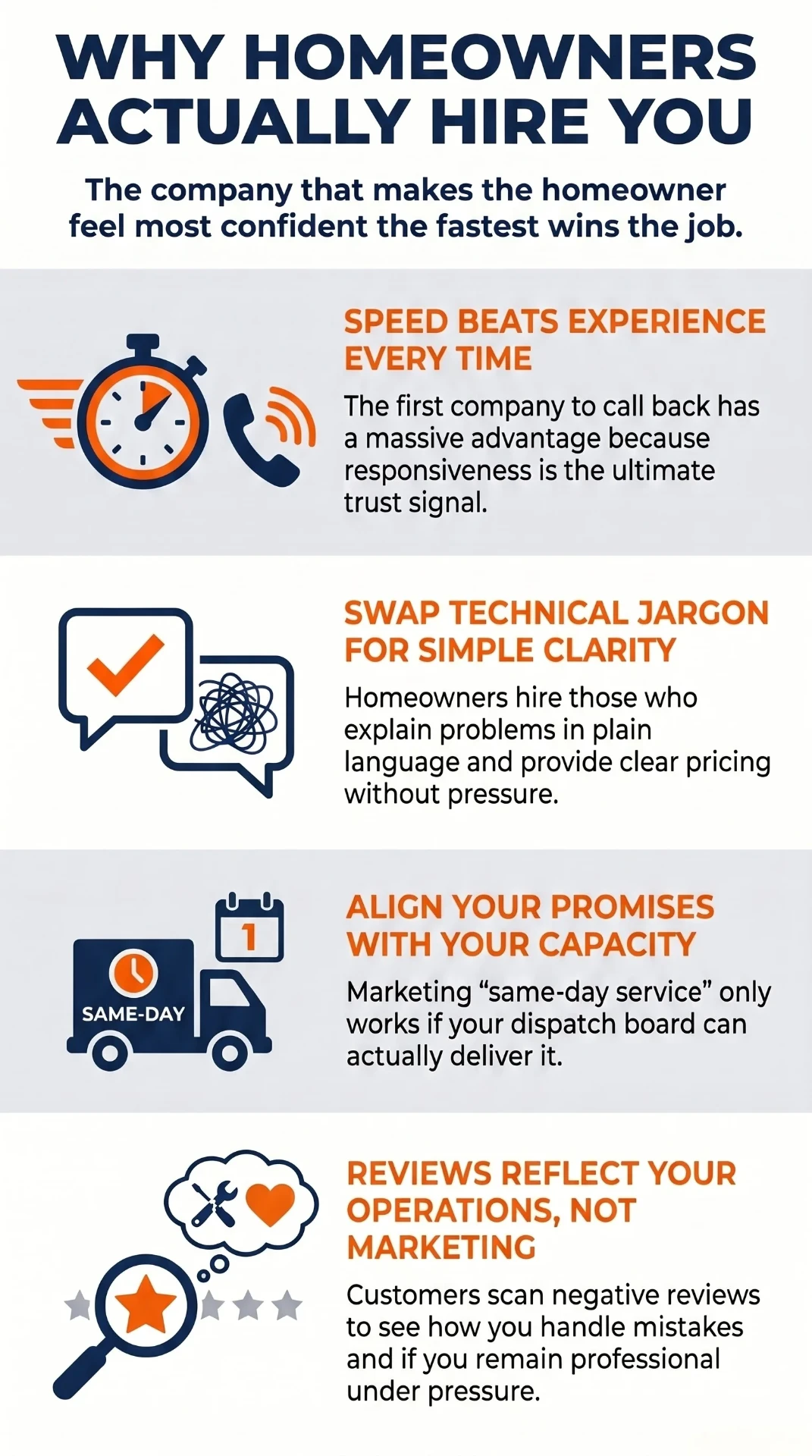
Homeowners hire based on what they actually experience during the first five minutes of contact.
And those two things are almost never the same.
The company that gets hired isn't always the best.
It's the one that made the homeowner feel the most confident
the fastest.
You're Marketing to Yourself, Not to the Customer
This is the disconnect we see over and over again in HVAC businesses. The website talks about the owner's credentials.
The ads emphasize years in business. The service pages list every piece of equipment the team can work on.
But that's not the real issue.
None of that is what a homeowner is thinking about when their AC dies at 8pm on a Friday.
They're thinking: who will pick up the phone? How fast can they get here? Will they explain what's wrong without making me feel stupid? Will the price be what they said it would be?
This is one of the core reasons most HVAC marketing fails before it starts. The messaging is built around the business, not around what the customer actually needs to hear to say yes.
And this is where most HVAC companies get it wrong.
They invest in marketing that talks past the customer. The customer doesn't care about your NATE certifications until after they trust you. They don't care about your equipment brands until after they believe you'll show up on time.
The First Thing: Speed of Response
According to the U.S. Bureau of Labor Statistics, there are roughly 425,200 HVAC technicians working across the country, with about 40,100 openings projected annually through 2034.
The industry is growing, which means homeowners have more choices than ever.
More choices means the bar for responsiveness keeps going up.
Think about it.
When a homeowner calls three companies, whoever calls back first has a massive advantage.
Not because they're better.
Because they demonstrated the one thing the homeowner cares about most in that moment: they showed up.
Speed of response isn't just a customer service metric. It's a trust signal.
A homeowner who waits four hours for a callback is already forming an opinion about what the rest of the experience will be like.
This connects directly to operations. If your team is overbooked and your CSRs are overwhelmed, response time suffers.
That's not a marketing problem.
It's a capacity problem.
Understanding your team's true weekly capacity is the first step toward making sure the customer experience matches the promises your marketing is making.
The company that calls back in ten minutes
beats the company with twenty years of experience
every single time.
The Second Thing: Clarity Before the Sale
Homeowners are not HVAC experts. They don't know what a capacitor is. They don't know why their system is short-cycling.
They just know something is wrong and they need it fixed.
Now this is where it gets interesting.
The companies that win aren't the ones with the most technical knowledge.
They're the ones who can explain the problem in plain language, give a clear price before starting work, and not make the homeowner feel like they're being upsold.
According to ENERGY STAR's heating and cooling guidance, nearly half of a home's energy bill goes to heating and cooling. Homeowners know this system matters.
They know it's expensive. What they need from you is the confidence that you're being straight with them about what it costs and why.
Let's be honest.
The HVAC industry has a trust problem. Too many homeowners have been burned by surprise charges, phantom repairs, and techs who diagnosed a problem differently than the next company.
Every homeowner who calls you is carrying that baggage.
Your job isn't just to fix the system. It's to make the experience feel honest from the first phone call to the final invoice.
We see this pattern constantly. The companies with the highest close rates aren't the cheapest.
They're the ones who explain the diagnosis clearly, present options without pressure, and follow up when they say they will.
Homeowners don't hire the most qualified company.
They hire the one that made the process feel simple.
The Third Thing: Can You Actually Show Up?
This sounds obvious. But it's the one that trips up more HVAC companies than anything else.
According to the EIA's Residential Energy Consumption Survey, space heating and air conditioning account for 52% of a household's annual energy consumption.
When that system goes down, the homeowner's comfort and safety are compromised.
They need someone who can get there. Not next week. Now.
Here's what we've seen.
Companies advertise same-day service. They promote emergency availability. Then a lead comes in and the earliest slot is three days out.
That gap between the promise and the reality is where trust dies. And once it's gone, no amount of marketing brings it back.
This is why we think about marketing as a system, not a campaign.
The marketing creates the demand. But the operation has to deliver on what the marketing promised.
If those two things are out of sync, your website stops converting and your reputation takes the hit.
Before you spend another dollar on ads or SEO, run through the HVAC capacity planning checklist.
Make sure you can actually deliver what your marketing says you can. The homeowner doesn't care about your ad budget.
They care about whether you showed up when you said you would.
The best marketing in the world can't outrun
an operation that can't keep its promises.
The Fourth Thing: What Other People Say About You
Homeowners check reviews. Every single one of them.
But not the way most companies think.
They're not reading every five-star review looking for validation. They're scanning for the negative ones.
They want to know what went wrong and how the company handled it.
HARDI's monthly distribution trends data tracks how the broader HVAC market shifts season to season.
When demand spikes and contractors get stretched thin, that's when the most revealing reviews get written.
The ones about missed appointments, long wait times, and techs who seemed rushed.
Those reviews tell the real story about a company's operational limits.
Think about it.
A homeowner doesn't just want to see that you have 200 reviews. They want to see that when something went wrong, you made it right.
They want to see consistency.
They want to see that you respond to criticism like a professional, not like someone who got their feelings hurt.
Knowing how many leads your HVAC company actually needs matters here too.
Companies that chase more leads than their team can handle end up with rushed jobs, missed details, and the kind of customer experiences that generate bad reviews.
Volume without capacity control is a reputation risk.
Your reviews don't just reflect your marketing.
They reflect your operations.
Fix the operation and the reviews fix themselves.
What This Means for Your Business
Understanding how HVAC marketing actually works means understanding that the customer's decision happens before they ever talk to a salesperson.
It happens on the first phone call.
In the first page they see on your website.
In the first review they read.
Let's break this down.
If your marketing promises speed but your dispatch board is overloaded, you lose.
If your website talks about expertise but doesn't show a single real review, you lose.
If your tech explains the problem in jargon and hands over an invoice with surprise charges, you lose.
The companies that win aren't spending more on marketing. They're aligning their marketing with their operations.
Every promise matches a capability. Every message reflects what actually happens when the customer calls.
According to ACCA's research on service agreements, recurring service agreements now represent 55% of HVAC industry revenue. That number exists because the companies earning that recurring revenue figured out how to deliver a customer experience worth coming back to.
Not once.
Every time.
Where to Start
Call your own company. See how long it takes to reach a real person. See what the experience feels like from the customer's side.
Read your last twenty reviews. Not the five-star ones. The three-star ones. The ones where the customer was almost happy but something fell short. That's where the real feedback lives.
Look at your website through the homeowner's eyes. Not what you want to say. What they need to hear. Can they tell within five seconds that you'll show up fast, explain things clearly, and charge fairly?
Check your availability against your marketing. If your ads say same-day service, make sure your dispatch board can back that up this week. Not last month. This week.
Stop marketing what you are. Start marketing what the customer experiences.
Homeowners aren't hiring your credentials.
They're hiring the experience you deliver.
Make sure those are the same thing.