You redesigned the website. You added new photos. Maybe you even paid a designer to make it look more professional.
Traffic is up. Google says people are finding you.
But the phone isn't ringing any more than it was before.
Here's the thing.
The problem with most HVAC websites isn't how they look. It's what they do. Or more accurately, what they don't do.
They don't convert visitors into booked jobs. And no amount of design polish will fix that if the structure underneath is broken.
A pretty website that doesn't book jobs
is just a digital brochure nobody asked for.
The Real Problem Isn't Your Design
Most HVAC companies treat their website like a storefront window.
Make it look nice, put the logo up, list the services, add a phone number.
Done.
But that's not the real issue.
A website for an HVAC company is not a brand exercise. It's a conversion tool. Its only job is to take a visitor who has a problem and turn them into a booked appointment on your dispatch board.
This is exactly where most HVAC marketing fails before it starts. Companies invest in driving traffic to a website that was never built to convert that traffic into work.
The disconnect isn't between you and Google.
It's between your website and your operations.
And this is where most HVAC companies get it wrong.
They hire a web designer who makes something clean and modern. But that designer has never dispatched a tech. They've never thought about what happens between someone landing on a service page and a CSR picking up the phone.
The website looks great and does nothing.
Trust Is the First Thing That's Missing
According to the U.S. Bureau of Labor Statistics, there are roughly 425,200 HVAC technicians working across the country. That means in any given market, a homeowner has dozens of options when their system breaks down.
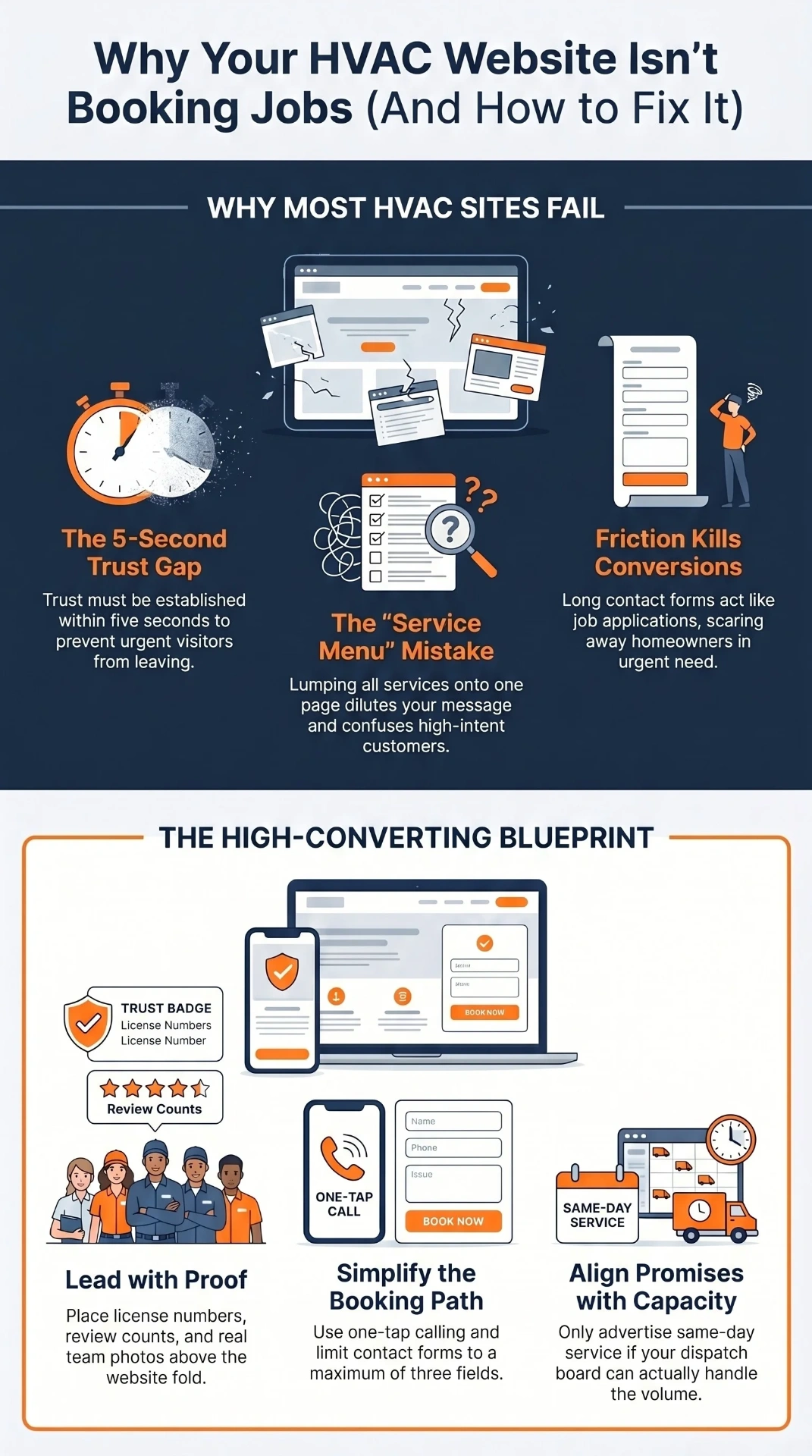
Your website has about five seconds to answer one question: can I trust this company?
Think about it.
If a homeowner's AC goes out in July, they're not browsing.
They're desperate.
They open three tabs, glance at each site, and call the one that feels most trustworthy.
Not the prettiest one.
The one that feels like a real company with real people who will actually show up.
That means your website needs to answer trust questions immediately.
Are you licensed? Insured?
How long have you been in business?
Do you have real reviews?
Can I see your team?
We see this constantly in HVAC businesses. The company has 200 five-star reviews on Google, but not a single testimonial on their website.
They've been operating for 15 years, but you'd never know it from the homepage.
The trust signals exist.
They're just not on the page.
Your reputation lives on Google.
But the conversion happens on your site.
If the trust isn't there, the call doesn't happen.
Your Pages Are Built for You, Not for the Customer
Here's what we've seen.
Most HVAC websites have a services page that lists every service the company offers.
AC repair. Furnace installation. Duct cleaning. Heat pumps. Indoor air quality. Commercial. Residential.
Sometimes twenty different services on one page.
That's not a conversion page. That's a menu. And menus don't book jobs.
According to the EIA's Residential Energy Consumption Survey, space heating and air conditioning account for 52% of a household's annual energy consumption.
Homeowners care deeply about their HVAC systems.
But when they land on your site, they don't want to read a catalog.
They want to know you can solve their specific problem right now.
Let's break this down.
Every high-intent service needs its own page. AC repair is not furnace installation. A homeowner searching for emergency AC repair needs to see availability, speed, and pricing clarity.
A homeowner researching a new system needs to see equipment options, financing, and the process from estimate to install.
When you lump everything together, you dilute the message. The visitor can't find themselves on the page. So they leave.
This connects directly to understanding how HVAC marketing actually works. The path from demand to a scheduled job has distinct stages, and your website pages need to match those stages.
A service call visitor is in a different mindset than an install prospect. Your pages should reflect that.
The messaging difference between service and install is significant enough that it should shape your entire site structure. We broke this down in detail in how capacity changes your marketing strategy for service vs install.
The revenue mix, the dispatch model, the sales cycle.
All of it is different.
Your website needs to account for that, not pretend it's one business.
A website built for the owner lists everything the company does.
A website built for the customer answers one question at a time.
The Booking Path Has Too Much Friction
Now this is where it gets interesting.
You could have great trust signals and strong service pages. But if the actual act of contacting you is harder than it should be, you're still losing jobs.
Look at your website from a phone.
Can someone call you in one tap?
Is the phone number sticky at the top?
Is there a way to request service without filling out a ten-field form?
Most HVAC websites bury the conversion action. The phone number is in the footer.
The contact form asks for the customer's address, equipment type, preferred date, and a detailed description of the problem.
That's not a contact form. That's a job application.
Let's be honest.
A homeowner with a broken AC at 9pm is not going to fill out a seven-field form. They're going to call the next company on the list.
Or they're going to text.
Or they're going to click the one that has a simple two-field request form and a promise to call back in under ten minutes.
ENERGY STAR notes that nearly half of a home's energy costs go to heating and cooling.
When that system fails, the homeowner isn't shopping casually.
They're in urgent mode.
Your website's booking path needs to match that urgency, not slow it down.
This is why we don't start with design.
We start with the conversion path.
What does a visitor need to do to become a booked job?
Then we remove everything that gets in the way.
Every extra field on your contact form
is a reason for the customer to leave.
Your Website Doesn't Reflect What You Can Actually Handle
This is the one nobody talks about.
Your website might promise 24/7 emergency service. Same-day response. Free estimates.
But when someone actually calls, what happens?
The CSR puts them on hold. The earliest available slot is three days out. The estimate takes a week to schedule.
That's a capacity problem showing up as a website problem. And it kills trust faster than a bad design ever could.
Before you worry about what your website says, you need to understand what your team can actually deliver. That starts with knowing your team's true weekly capacity.
If you're advertising availability you can't back up, your website is making promises your operations can't keep.
Here's what we've seen.
According to ACCA's data on service agreements, recurring service agreements now represent 55% of HVACR industry revenue.
That means most of your techs' time is already spoken for.
If your website is generating leads on top of that without accounting for the capacity those agreements consume, you're overloading a system that's already full.
Figuring out how many leads your company actually needs is a prerequisite to building a website that converts properly.
The goal isn't maximum traffic.
The goal is the right amount of demand matched to what your team can absorb without the experience falling apart.
A high-converting website aligned to a team that can't deliver
doesn't grow your business. It damages your reputation.
What a Converting HVAC Website Actually Looks Like
It doesn't need to be complicated. But it does need to be intentional.
Every page should have one clear action the visitor can take. On service pages, that's calling or requesting an appointment.
On install pages, that's scheduling a consultation.
Don't split the visitor's attention between five different options.
Trust signals need to be above the fold. License number. Years in business. Review count with a link to the reviews. A real photo of your team, not a stock image of a smiling guy in a hard hat.
The booking path needs to be frictionless. Phone number visible and tappable on mobile. A short contact form with two to three fields maximum. Response time clearly stated.
And the messaging needs to match your operations. If you can do same-day service, say it. If you can't, don't. Promise what you can deliver, and deliver what you promise.
Before you spend money on redesigning your website or driving more traffic to it, run through the HVAC capacity planning checklist.
Make sure your operations are ready to handle what a well-built site will produce. Otherwise you're just accelerating a problem.
Where to Start
Pull up your website on your phone. Not your laptop. Your phone. That's how most of your customers see it.
Try to book a service call. Time how long it takes. Count the steps. Count the fields. If it takes more than thirty seconds, it's too slow.
Check your homepage. Can a visitor tell what you do, where you serve, and why they should trust you within five seconds? If not, fix that first.
Look at your service pages. Do you have separate pages for your highest-intent services, or is everything lumped together? Separate them.
Audit your promises. Does your website say things your operations can't consistently deliver? Fix the gap before you drive more traffic.
The best HVAC websites don't look the best.
They book the most jobs.
That's the only metric that matters.