Most HVAC companies don't have a marketing problem.
They have an infrastructure problem.
They're running ads without a website that converts. They're generating leads without a dispatch system that can absorb them.
They're spending on SEO without knowing whether their team can handle what organic traffic produces.
Here's the thing.
Marketing isn't a switch you flip.
It's a system you build. And that system has layers.
When one layer is missing, the whole thing underperforms. Not because the tactics are wrong.
Because the foundation isn't there.
Tactics without infrastructure is just noise with a budget.
Infrastructure without tactics is a machine waiting to run.
Why Campaigns Fail and Systems Don't
The typical HVAC marketing approach looks like this: hire an agency, launch some Google Ads, maybe invest in SEO, wait for the phone to ring.
When it doesn't ring enough, spend more.
But that's not the real issue.
The real issue is that none of those tactics were built on anything. There's no measurement. No feedback loop between what the marketing produces and what the operations can handle.
We covered this in detail in why most HVAC marketing fails before it starts. The failure point is almost never the platform or the ad creative. It's the absence of structure underneath.
And this is where most HVAC companies get it wrong.
They buy tactics when what they need is infrastructure. They chase leads when what they need is a predictable pipeline connected to a team that can deliver.
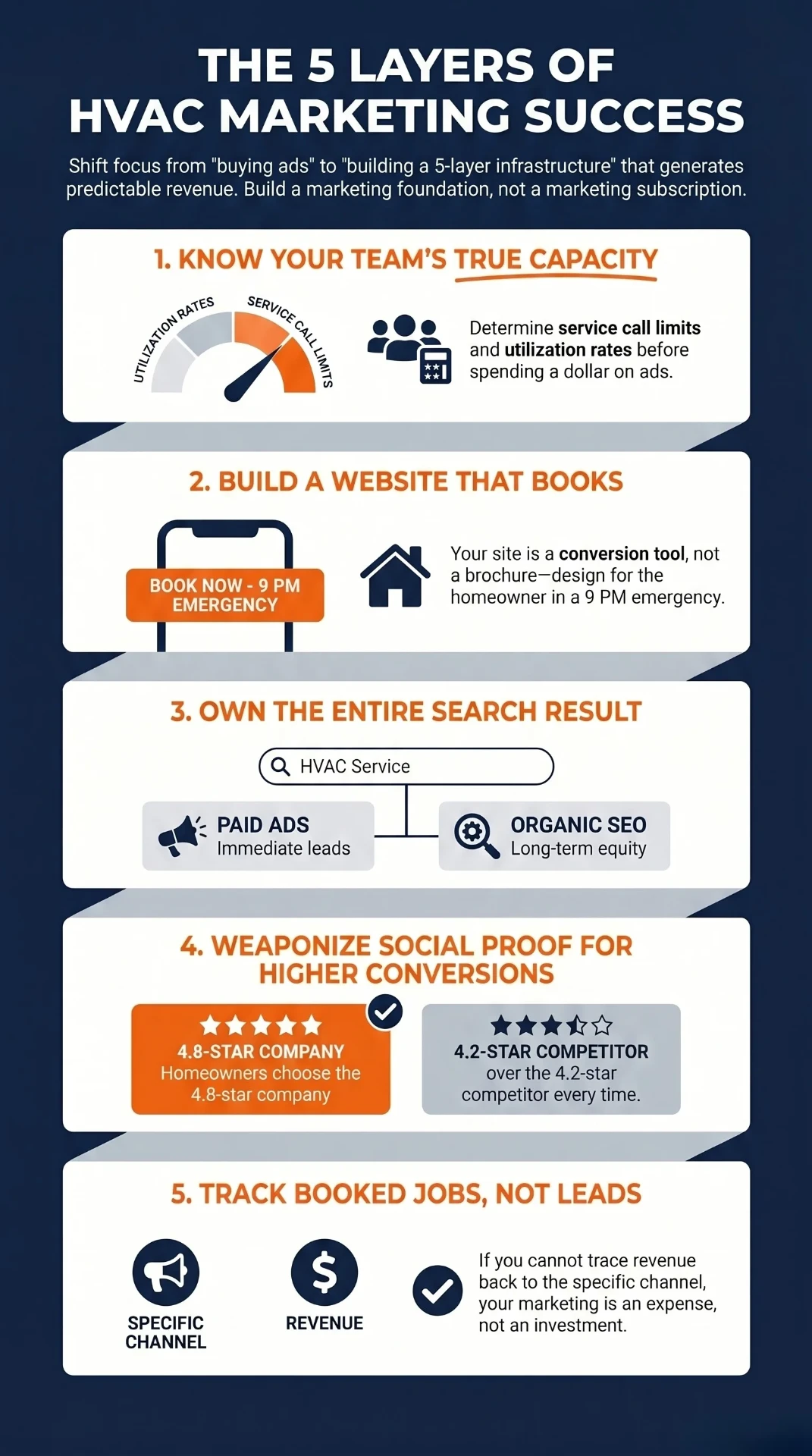
Layer One: Know What Your Business Can Handle
Everything starts here. Not with ads. Not with keywords. With capacity.
Think about it.
According to the U.S. Bureau of Labor Statistics, HVAC technician employment is projected to grow 8% from 2024 to 2034, with about 40,100 openings each year. The industry is expanding.
But growth doesn't mean every company is ready to absorb more demand.
Most aren't.
Before you build any marketing infrastructure, you need to know your team's true weekly capacity.
How many service calls can your techs complete per day?
How many installs per week?
What's your real utilization rate once you account for drive time, callbacks, and non-billable hours?
Those numbers set the ceiling for everything that follows.
Your ad budget.
Your lead volume targets.
Your staffing plan.
This is also why understanding how many leads your company actually needs is a prerequisite, not an afterthought.
The right number isn't "more."
It's the precise volume your team can convert without the experience falling apart.
The first layer of marketing infrastructure has nothing to do with marketing.
It's operations.
Layer Two: A Website That Converts, Not Just Exists
Once you know your capacity, the next layer is the thing that turns traffic into booked jobs.
Let's be honest.
Most HVAC websites are digital brochures.
They look fine.
They say the right generic things.
And they convert at a fraction of what they should because nobody built them with a conversion path in mind.
We broke this down in why your HVAC website isn't converting. The problems are almost always the same: buried phone numbers, too many form fields, no trust signals above the fold, and messaging that talks about the company instead of the customer.
According to ENERGY STAR's heating and cooling guidance, nearly half of a home's energy bill goes to heating and cooling.
When that system fails, the homeowner is urgent. Your website has seconds to prove you're the right call. If the messaging doesn't match what homeowners actually care about, they leave.
Now this is where it gets interesting.
The messaging layer is its own discipline.
We put together a website messaging checklist specifically because most HVAC companies get this wrong.
They write for themselves.
Not for the homeowner standing in a hot house at 9pm trying to decide who to call.
This is what website design and conversion optimization actually means when we talk about it.
Not a redesign for the sake of aesthetics.
A rebuild around conversion.
Every element justified by whether it moves a visitor closer to a booked call.
A website is not a brochure.
It's the conversion layer of your infrastructure.
If it doesn't book jobs, it's decoration.
Layer Three: Getting Found When It Matters
You've got the capacity. You've got a website that converts. Now you need the traffic.
Here's what we've seen.
HVAC companies jump straight to paid ads because the results are immediate. And they can be. But paid traffic without organic visibility is renting demand.
The moment you stop paying, the leads stop.
That's not infrastructure.
That's a subscription.
According to the EIA's Residential Energy Consumption Survey, space heating and air conditioning account for 52% of a household's annual energy consumption. The demand for HVAC services isn't going away.
The question is whether homeowners find you or your competitor when they search.
That's where search engine optimization becomes a foundational layer, not a nice to have. Organic search visibility compounds over time.
Every page you build, every question you answer, every service area you target adds to a base of traffic that doesn't disappear when your ad budget runs out.
And it's not just traditional search anymore. Generative search optimization is becoming a real factor.
AI-powered search results pull answers from websites that demonstrate clear expertise and structured content.
If your site isn't built for that, you're invisible to a growing segment of searchers.
Let's break this down.
At the local level, your Google Business Profile and local search presence determines whether you show up in the map pack when someone searches "AC repair near me."
That one listing drives more calls than most companies realize. And paid search and Local Services Ads sit on top of that, capturing the high intent traffic that's ready to book right now.
Paid ads rent attention.
Organic search builds equity.
Infrastructure uses both.
Layer Four: Reputation as a Conversion Multiplier
Traffic and visibility get people to your site. Reputation is what gets them to call.
HARDI's distribution trends data shows the HVAC market maintaining steady growth through 2025. In a growing market, homeowners have options.
Your reputation is what makes them choose you over the company in the same search results.
Think about it.
A homeowner looks at two companies side by side. Both show up on Google. Both have decent websites. One has 47 reviews at 4.2 stars. The other has 280 reviews at 4.8 stars with thoughtful responses to every complaint. The second company gets the call.
This is why reputation management is a layer of infrastructure, not a side project. It's not about chasing five-star reviews.
It's about building a body of evidence that tells the homeowner your team delivers consistently. And it feeds directly back into your website conversion rate. More proof, more calls.
We see this pattern constantly. Companies with strong operational delivery but weak review volume lose to competitors who are worse at the work but better at collecting social proof.
Reputation isn't a marketing tactic.
It's the compound interest of consistent delivery.
Layer Five: Measurement That Actually Tells You Something
This is where infrastructure separates itself from activity.
Here's what we've seen.
Most HVAC companies track leads. Maybe they track cost per lead. But they have no idea what their cost per booked job is or which channels produce the jobs that actually show up on the dispatch board.
According to AHRI's monthly shipment data, millions of units move through the channel every year. In May 2025 alone, 474,500 air conditioners and 387,600 heat pumps shipped into distribution.
Your marketing needs to respond to those demand patterns. But you can't respond to what you can't measure.
This is why marketing analytics and reporting is the layer that holds everything else accountable.
Not vanity metrics.
Not impressions and click-through rates.
Real tracking: which channels produce booked jobs, at what cost, with what close rate, and how those numbers change over time.
Understanding how HVAC marketing actually works means understanding that the path from demand to a scheduled job has measurable checkpoints at every stage.
If you're not measuring each one, you're guessing. And guessing isn't infrastructure.
If you can't trace a booked job back to the channel that produced it,
you don't have marketing infrastructure.
You have an expense.
How the Layers Work Together
According to ACCA's quality installation standards, the correct design, proper installation, and final testing have a significant impact on customer satisfaction.
The same principle applies to marketing infrastructure.
Each layer needs to be designed correctly and tested against real results.
The revenue mix matters too. A service-heavy company and an install-heavy company need different infrastructure configurations.
Service businesses need high-frequency lead flow.
Install businesses need nurture sequences.
Your infrastructure has to match your business model.
This is why we don't start with ads. We don't start with SEO.
We start with the foundation.
Capacity.
Conversion.
Visibility.
Reputation.
Measurement.
Five layers, each built on the one below it.
Where to Start
Audit your capacity first. Use the capacity planning checklist to know your numbers before you spend anything. That's what real growth strategy looks like. Not a pitch deck. A capacity audit.
Look at your website through the customer's eyes. Not what it says. What it does. Does it book calls or just exist?
Check your visibility across all three channels: organic search, local search, and paid. If you're only using one, you're leaving demand on the table.
Count your reviews. Read the three-star ones. They tell you what's breaking.
Track booked jobs, not leads. Leads are an activity metric. Booked jobs are a revenue metric. Build your reporting around the one that matters.
Marketing infrastructure isn't built in a day.
But every day without it costs you booked jobs
you'll never know you lost.