Ask an HVAC company where most of their calls come from and they'll say Google.
Ask them what part of Google and you'll get a vague answer about ads or organic search.
Here's the thing.
For most local HVAC companies, the single biggest driver of inbound calls isn't a paid ad or a blog post.
It's the Google Business Profile. The map listing.
The three-pack that shows up when a homeowner types "AC repair near me" at 9pm on a Saturday.
And most HVAC companies treat it like an afterthought.
They claimed the listing years ago, uploaded a logo, and forgot about it.
Then they wonder why the phone isn't ringing as much as the competitor down the road.
Your Google Business Profile isn't a listing.
It's the front door to your business
for every homeowner searching locally.
The Profile Most HVAC Companies Ignore
This is one of the patterns we covered in why most HVAC marketing fails before it starts. Companies invest in tactics without building the foundation underneath. And GBP is foundational.
It sits at the intersection of visibility, trust, and conversion. When it's neglected, everything downstream suffers.
But that's not the real issue.
The real issue is that most operators don't understand how much their GBP profile influences the lead volume that hits their phone.
They think of it as a directory listing. It's not. It's a decision making tool for homeowners. And Google gives it more weight than almost anything else in local search.
And this is where most HVAC companies get it wrong.
They spend thousands on ads while the free asset that drives the most local calls sits incomplete, outdated, or worse, unverified.
Why GBP Drives More Calls Than You Think
According to the U.S. Bureau of Labor Statistics, there are roughly 425,200 HVAC technicians working across the country.
In any local market, that translates to dozens of companies competing for the same homeowner's attention. GBP is the primary filter homeowners use to narrow that list.
Think about it.
When someone searches for HVAC service on their phone, the first thing they see isn't your website.
It's the map pack.
Three businesses with star ratings, review counts, hours, and a call button.
That's the entire consideration set for most homeowners. If you're not in those three spots, you don't exist for that search.
Understanding how HVAC marketing actually works means understanding that the path from demand to a booked job starts right here.
Not on your homepage.
Not in your ad copy.
In the map pack.
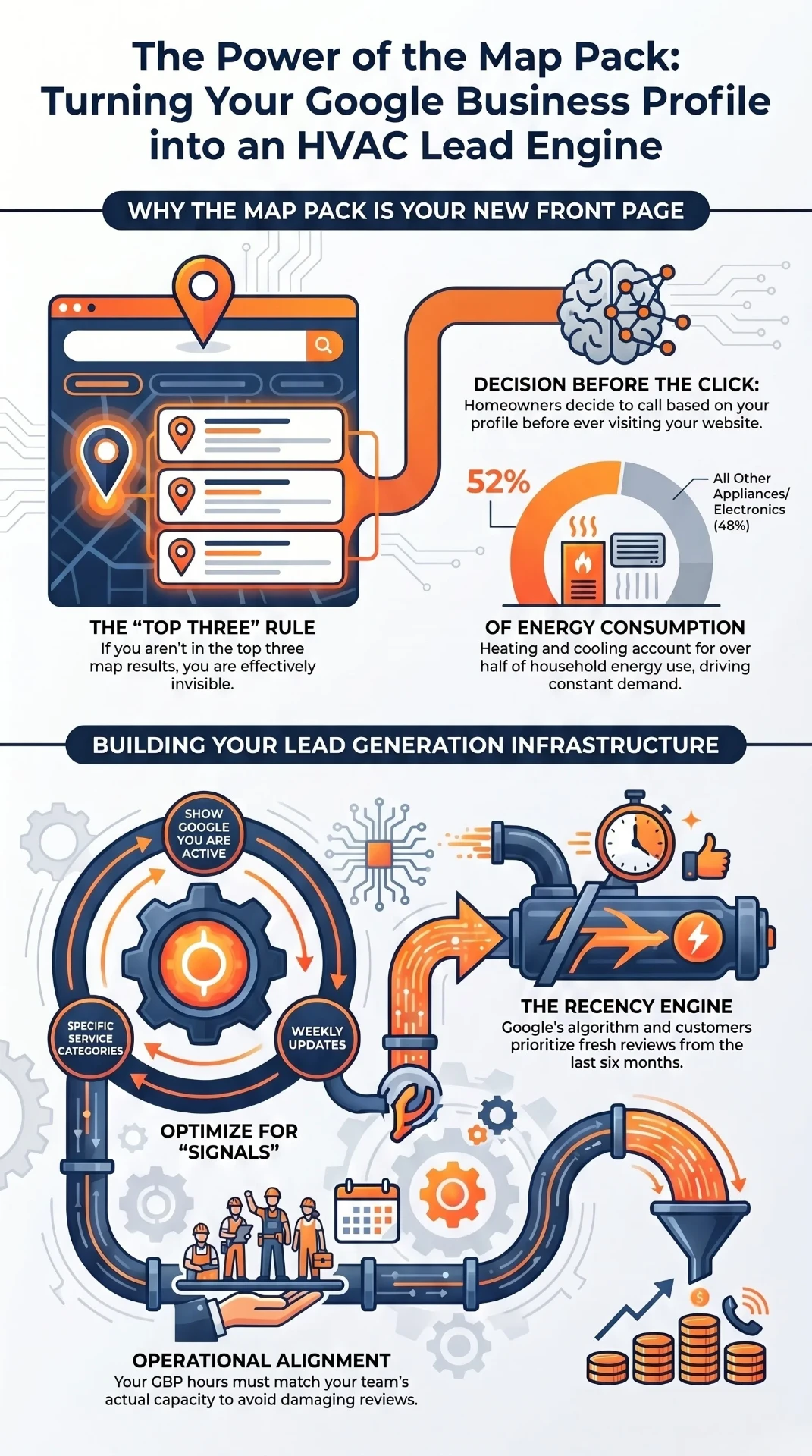
The homeowner decides whether to call you before they ever see your website.
This is also why local SEO and Google Business Profile optimization is one of the highest leverage investments an HVAC company can make. It directly controls where you show up in the moment the homeowner is ready to call.
The map pack is the new front page.
If you're not in the top three,
you're invisible to the customer who's ready to call.
Reviews Are the Conversion Engine Inside Your Profile
GBP visibility gets you seen. Reviews get you chosen.
Let's be honest.
A homeowner scrolling through three HVAC companies in the map pack is making a snap judgment.
They're not reading your service descriptions.
They're looking at your star rating, your review count, and whether your most recent reviews are from this month or last year.
According to ENERGY STAR's heating and cooling guidance, nearly half of a home's energy bill goes to heating and cooling.
When that system fails, the homeowner is making an urgent, high-stakes decision.
They're choosing the company that feels most trustworthy in the shortest amount of time.
Your review profile is the fastest shortcut to that trust.
We covered this in depth in what homeowners actually look for when hiring an HVAC company. Speed, clarity, and proof. Reviews provide all three. A fresh review that says "they showed up the same day and had it fixed in an hour" does more selling than any ad you could write.
Now this is where it gets interesting.
It's not just about volume. It's about recency and response.
A profile with 50 reviews from two years ago tells a different story than a profile with 50 reviews from the last six months.
Google's algorithm cares about recency. And homeowners care about whether you're paying attention.
This is why reputation management isn't a side project. It's a lead generation system that lives inside your GBP. Every completed job is a chance to earn a review that puts you higher in the map pack and makes the next homeowner more likely to call.
Reviews don't just reflect your reputation.
They build your visibility.
Every review is a ranking signal and a trust signal at the same time.
What Your Profile Tells Google About Your Business
Here's what we've seen.
Most HVAC companies fill in the basics and stop. Company name. Address. Phone number. Maybe a few photos from when the listing was first set up.
But Google uses far more than that to determine who shows up in the map pack. Categories. Service descriptions. Hours. Attributes. Posts. Photos. The more complete your profile, the more signals Google has to match you with relevant searches.
According to the EIA's Residential Energy Consumption Survey, heating and air conditioning account for 52% of a household's annual energy consumption.
That creates year round search demand across dozens of categories: AC repair, furnace replacement, heat pump installation, maintenance plans. If your GBP only lists a few categories, you're invisible for the rest.
Let's break this down.
Your primary category should match your highest-volume service. Your secondary categories should cover every relevant service type: air conditioning repair, furnace repair, HVAC contractor, heating equipment supplier.
Each category is a door that opens your profile to a different set of searches.
Posts keep your profile active. Google rewards profiles that show recent activity. A weekly post about a completed job or a seasonal tip tells Google your business is engaged.
This connects to the broader organic search strategy that supports your GBP. Your website content, your blog posts, your service pages all send relevance signals that reinforce what Google sees on your profile. They work together, not separately.
A half-finished profile gets half the visibility.
Google rewards completeness.
Fill every field or lose to the competitor who does.
Your Profile Has to Match What Your Team Can Deliver
This is the piece most operators miss entirely.
Your GBP says you're open 24/7. Your hours say Saturday and Sunday availability. Your posts say same-day emergency service.
But when a homeowner calls at 7pm on a Sunday, the phone goes to voicemail.
That disconnect kills lead conversion faster than any algorithm change ever will. Before you optimize your profile, you need to know your team's true weekly capacity. Your GBP hours, your service promises, and your response time all need to reflect what your team can actually handle.
According to ACCA's research on service agreements, recurring service agreements now represent 55% of HVAC industry revenue. A significant portion of your techs' time is already committed. If your GBP is generating leads on top of that existing workload, the math has to work. Otherwise you're creating demand you can't serve, and the bad reviews that follow will undo everything.
Figuring out how many leads your company actually needs is critical here. Your GBP is a demand engine. If that engine produces more calls than your dispatch board can absorb, the homeowner experience suffers and your reviews reflect it.
An optimized profile that outpaces your operations
doesn't grow your business.
It damages it one missed call at a time.
GBP Is Infrastructure, Not a Tactic
We talked about the layers of HVAC marketing infrastructure and how each layer builds on the one below it. GBP sits at a unique crossroads. It touches visibility, reputation, and conversion all at once. Neglecting it weakens every layer above it.
HARDI's distribution trends data shows HVAC market growth holding steady through 2025. More demand means more competition for local visibility.
The companies treating GBP as infrastructure are the ones capturing a disproportionate share of that demand.
Your GBP also works in concert with paid search and Local Services Ads. A strong profile with high reviews and complete information improves your quality score on paid placements.
You pay less per lead when your organic profile backs up your ads.
We see this pattern constantly. Companies spending aggressively on ads with weak GBP profiles, wondering why their cost per lead is double what it should be.
The profile is the credibility layer. Without it, every other channel works harder for worse results.
Where to Start
Log into your Google Business Profile right now. Check every field. Is your primary category correct? Are your hours accurate? Is your phone number the one that gets answered?
Count your reviews from the last 90 days. If the number is less than ten, you need a system for requesting reviews after every completed job.
Not a reminder. A system.
Look at your most recent post. If it's older than two weeks, post something today. A completed job photo. A seasonal service reminder. Anything that tells Google your business is active.
Read your three-star reviews. They tell you exactly what's breaking in the customer experience. Fix those issues and the five-star reviews follow. If you need a framework for connecting your operations to your marketing spend, start there.
Track how many calls come directly from your GBP each month. If you're not measuring this separately from website calls and ad calls, start.
That's what real marketing analytics looks like. Know which channel produces which calls so you can invest accordingly.
Your Google Business Profile is the most undervalued asset
in your marketing system.
The companies that treat it like infrastructure
outperform the ones that treat it like a checkbox.