Your HVAC website has words on it. Every page says something.
The question is whether any of it is making someone pick up the phone.
Here's the thing.
Most HVAC websites are full of messaging that was written for the business owner, not the homeowner.
It talks about what the company does.
Not what the customer needs to hear in order to take action.
And the gap between those two things is where booked calls go to die.
If your website reads like a resume,
don't be surprised when nobody calls.
Homeowners hire confidence, not credentials.
The Messaging Problem Nobody Fixes
HVAC companies spend money on ads, SEO, and redesigns. They send traffic to their site. Some of it converts. Most of it doesn't.
But that's not the real issue.
The real issue is that the words on the page are doing nothing.
The homepage says something generic like "Quality HVAC service for your home."
The service pages list features.
The about page reads like an obituary of the company's founding story.
None of that answers the question the homeowner is actually asking: can I trust you to fix my problem quickly and fairly?
We covered this in detail in why your HVAC website isn't converting. The structure and the booking path matter.
But even a perfectly structured site fails if the messaging doesn't connect with what the visitor needs to hear.
And this is where most HVAC companies get it wrong.
They think messaging is about copywriting.
It's not.
Messaging is about alignment.
What your site says has to match what the customer cares about, what your team can deliver, and what actually gets someone to call instead of clicking away.
Homepage: Answer Three Questions in Five Seconds
A homeowner lands on your homepage. You have five seconds before they decide to stay or leave.
Think about it.
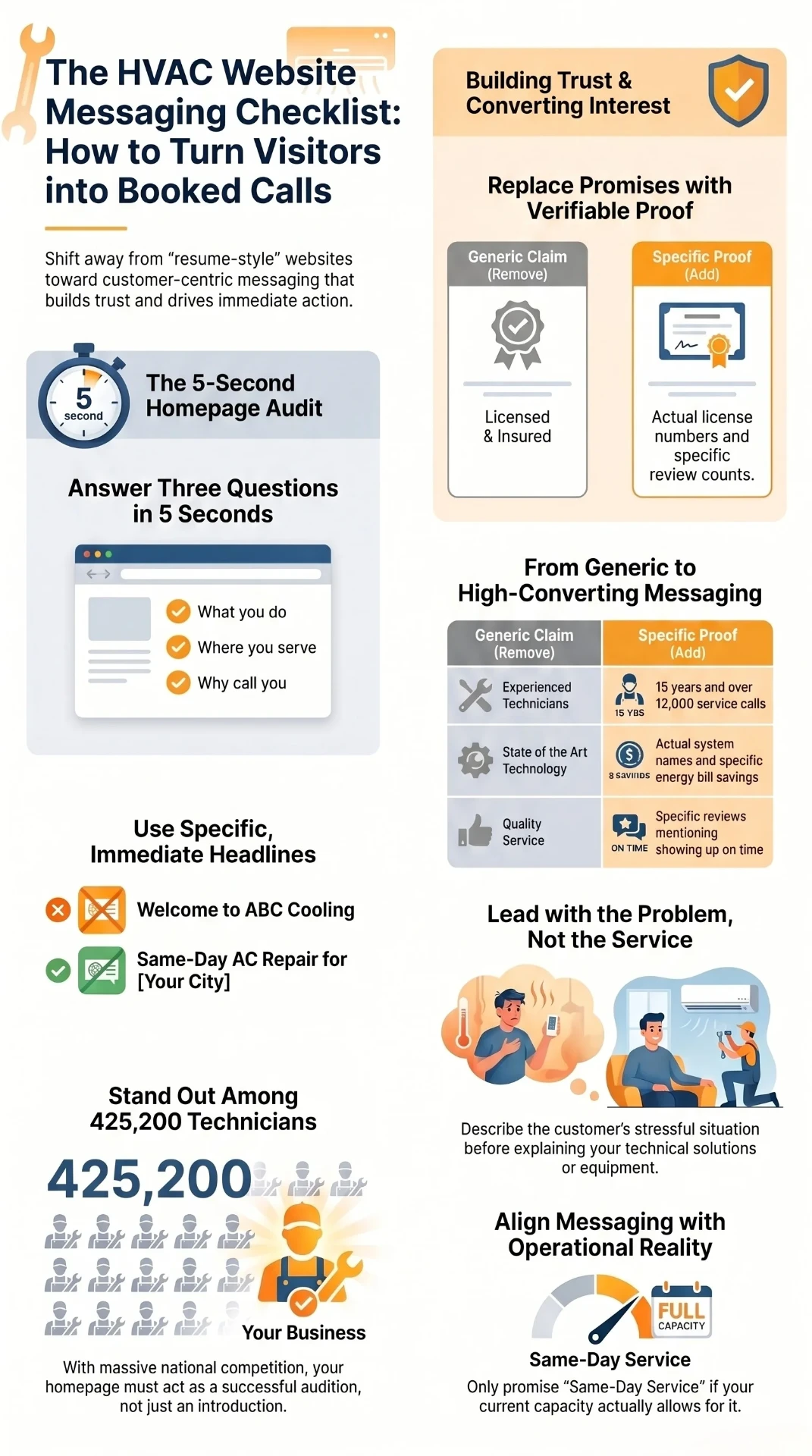
In those five seconds, your homepage needs to answer three things: what do you do, where do you do it, and why should I call you instead of the next company?
According to the U.S. Bureau of Labor Statistics, there are roughly 425,200 HVAC technicians across the country. In any given market, the homeowner has options.
Your homepage is where you either stand out or blend in.
The checklist for homepage messaging is simple:
Does the headline state what you do and who you serve? Not "Welcome to ABC Heating and Cooling."
Something like "Same-day AC repair and heating service for [your city]."
Specific. Clear. Immediate.
Is your service area visible above the fold? The homeowner needs to know you serve their neighborhood without scrolling.
Is there a trust signal within the first screen? Review count, years in business, or licensing. Something that answers "why you" before the homeowner even has to ask.
This ties directly into what homeowners actually look for when hiring an HVAC company.
Speed, clarity, and proof.
Your homepage messaging either delivers those three things immediately or it doesn't.
There's no middle ground.
Your homepage isn't an introduction.
It's an audition.
And the homeowner decides in five seconds.
Service Pages: Speak to the Problem, Not the Service
Here's what we've seen.
Most HVAC service pages describe what the company offers.
AC repair. Furnace installation. Duct cleaning.
They list the service and maybe add a paragraph about how they do quality work.
That's not messaging. That's a menu.
According to ENERGY STAR's heating and cooling guidance, nearly half of a home's energy bill goes to heating and cooling.
Homeowners understand the stakes.
What they need from your service page is not a description of what you do. They need to see that you understand their specific problem and can solve it.
Now this is where it gets interesting.
The best service page messaging starts with the customer's situation, not your capabilities.
Instead of "We offer AC repair," try "Your AC stopped working and it's 95 degrees. Here's what happens when you call us."
Then walk them through the experience.
What to expect on the phone. When you'll arrive. How pricing works.
What happens if you can't fix it on the first visit.
That's not copywriting. That's operational clarity turned into a webpage.
Understanding how HVAC marketing actually works means understanding that each service page serves a different stage of the buying process.
An emergency AC repair visitor and someone researching a new furnace installation are not in the same headspace.
Your messaging needs to match where they are, not lump them together.
A service page that describes what you do is a brochure.
A service page that describes what the customer will experience is a conversion tool.
Trust Language: Show It, Don't Claim It
Every HVAC website says they're trustworthy. Licensed. Insured. Experienced.
Let's be honest.
Nobody believes that anymore. Not because it's false. Because everyone says it. The words have been drained of meaning by overuse.
According to ACCA's quality installation standards, the correct design, proper installation, and final testing have a significant impact on both occupant satisfaction and energy savings.
That's real, verifiable proof. But most HVAC websites don't reference anything verifiable.
They just claim quality without evidence.
The messaging checklist for trust is about proof, not promises:
Replace "licensed and insured" with your actual license number and insurance details. Specificity is trust.
Replace "years of experience" with a specific number and a sentence about what that experience has taught you. "15 years and over 12,000 service calls" hits differently than "experienced technicians."
Replace generic testimonials with reviews that mention specific outcomes. A review that says "they showed up on time and fixed the issue in an hour" is worth more than ten reviews that say "great service."
AHRI's monthly shipment data tracks millions of equipment units moving through the channel every year.
Homeowners are making major purchase decisions in a competitive market.
The company that provides the most specific, verifiable proof of competence is the one that earns the call.
We see this pattern constantly.
The companies with the best messaging don't claim to be the best.
They show evidence of being reliable.
That's a fundamentally different approach.
Claims build walls.
Proof builds bridges.
Your website messaging should be full of bridges.
Messaging Has to Match What Your Team Can Deliver
This is the one most people skip. And it's the one that matters most.
Your website can promise same-day service. It can say "fast, reliable, always available."
But if a homeowner calls and the earliest slot is Thursday, your messaging just became a lie.
Before you write a single word of website copy, you need to know your team's true weekly capacity. How many service calls can your techs handle per day? How many install jobs per week?
Those numbers set the boundary for what your messaging is allowed to promise.
Here's what we've seen.
According to the EIA's Residential Energy Consumption Survey, space heating and air conditioning account for 52% of a household's annual energy consumption. When those systems fail, homeowners are urgent.
If your messaging creates urgency expectations your operations can't meet, you don't just lose the job.
You earn a bad review.
Figuring out how many leads your company actually needs is part of this equation. Your messaging drives demand. Your capacity determines whether that demand turns into great experiences or frustrated customers.
The two have to match.
This is why we always recommend running through the HVAC capacity planning checklist before touching your website messaging. Know what your team can handle first.
Then write messaging that reflects that reality.
The worst messaging on any HVAC website
is a promise the operations team can't keep.
What to Remove from Your Website Today
This is the part that often has more impact than anything you add. Understanding why most HVAC marketing fails before it starts means recognizing that clutter, vague language, and misaligned promises do active damage.
Let's break this down.
Remove any headline that could apply to any HVAC company in any city. If you could swap your company name for a competitor's and the headline still works, it's too generic.
Remove paragraphs that explain what HVAC is. Your customer knows their AC is broken. They don't need a Wikipedia entry about heating and cooling systems.
Remove stock photos of smiling people in hard hats. Use real photos of your team, your trucks, your work. Authenticity is a trust multiplier.
Remove any mention of "state of the art" or "cutting edge" technology.
These phrases are filler.
Replace them with the actual names of the systems you install and what they mean for the homeowner's comfort and energy bills.
HARDI's distribution trends data shows the HVAC market averaging steady growth through 2025, with distributor sales increasing roughly 3% to 4% annually.
The market is healthy.
Competition is real.
The companies that strip their messaging down to what actually matters, and cut everything that doesn't, are the ones converting visitors into calls.
The Checklist
Pull up your homepage right now.
Can a visitor tell what you do, where you serve, and why they should trust you within five seconds?
If not, rewrite the headline and the first two lines.
Open each service page.
Does it start with the customer's problem or with your service description?
Flip it. Lead with the situation. Follow with what you do about it.
Search your site for the words "quality," "professional," and "experienced." Replace every one with something specific and provable.
Check every promise against your current capacity. If your site says same-day and your board is booked three days out, update the messaging or fix the capacity. One or the other.
Read your site out loud. If any sentence sounds like it was written by a marketing agency for a company that doesn't exist, delete it and write what's actually true.
The best HVAC website messaging
doesn't sound like marketing.
It sounds like the truth, delivered clearly.