Everyone wants a number.
How many reviews do I need to rank?
How many before homeowners trust me?
How many to beat the competitor across town?
Here's the thing.
That's the wrong question.
The right number of reviews isn't a target you hit once and forget about. It's a pace you maintain. And that pace is directly tied to how well your business operates, not how aggressively you chase five stars.
Reviews aren't a scoreboard.
They're a speedometer.
They tell you how fast trust is building.
The Number Is a Distraction
HVAC companies ask "how many reviews do I need?" the same way they ask "how many leads do I need?" They want a benchmark. A finish line.
But that's not the real issue.
We addressed the lead volume question in how many leads an HVAC company actually needs.
The answer there wasn't a fixed number.
It was a function of capacity, close rates, and revenue targets.
Reviews work the same way. The "right" number depends on your market, your competitors, and how consistently you're earning new ones.
And this is where most HVAC companies get it wrong.
They obsess over total count. They look at the competitor with 500 reviews and panic.
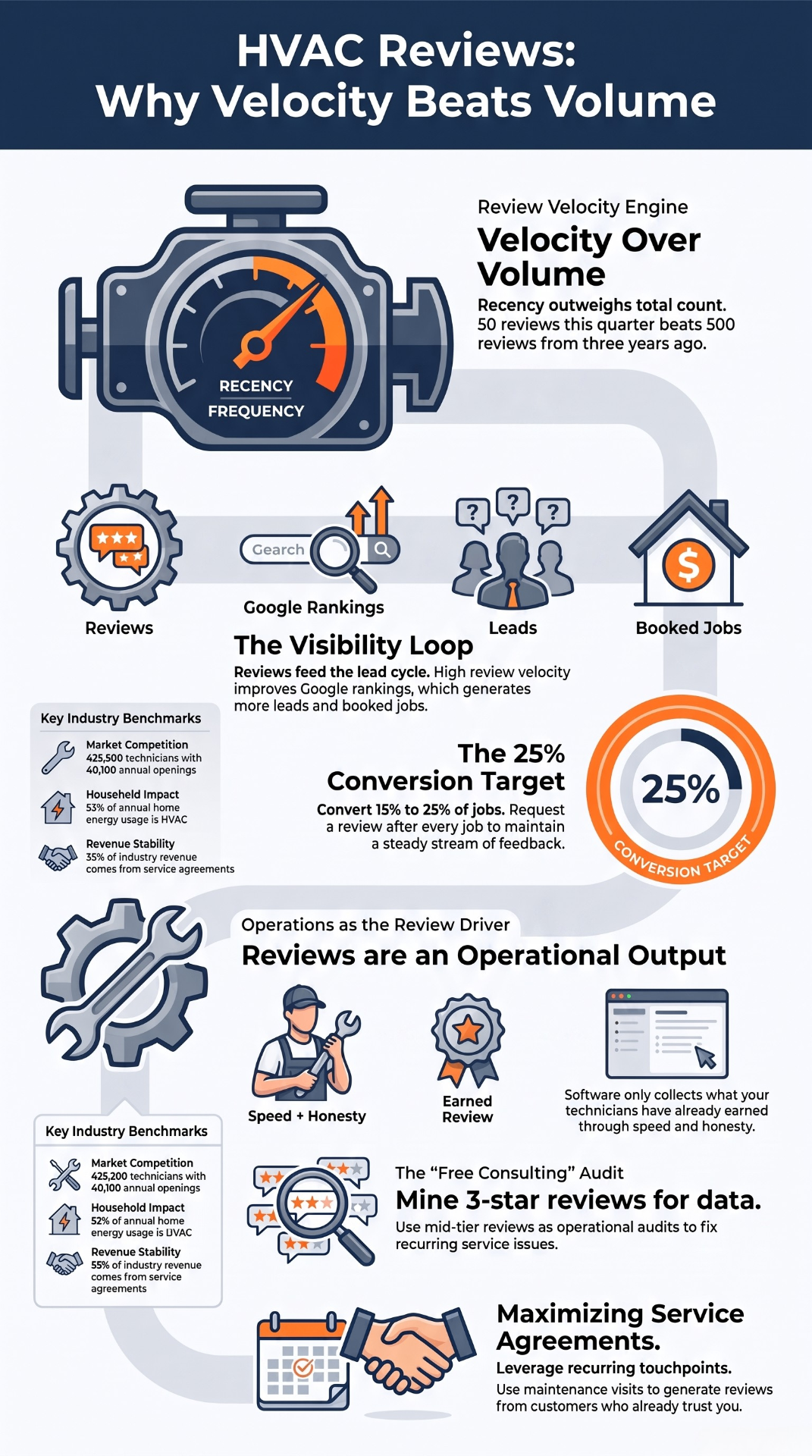
But a company with 500 reviews from three years ago is in a weaker position than a company with 120 reviews, 30 of them from the last 90 days.
This is one of the core patterns behind why most HVAC marketing fails before it starts. Companies chase a vanity metric instead of building the system that produces the metric naturally.
Velocity Matters More Than Volume
Google's algorithm doesn't just count your reviews. It weighs how recently they were posted. A steady stream of reviews signals that your business is active, current, and consistently serving customers.
Think about it.
A homeowner scrolling through the map pack sees your competitor with 200 reviews, last one posted yesterday. Then they see your profile with 150 reviews, last one posted four months ago.
The homeowner doesn't think "close enough."
They think "what happened to this company?"
We covered the full impact of this in how Google Business Profile affects lead volume. GBP rewards recency. Review velocity is one of the strongest local ranking signals. It's not about hitting a number. It's about never stopping.
According to the U.S. Bureau of Labor Statistics, there are roughly 425,200 HVAC technicians working across the country, with about 40,100 openings annually through 2034. Competition for local visibility is intensifying. In a crowded market, review velocity is what separates the companies that show up from the ones that fade out.
Fifty reviews this quarter
beats five hundred reviews from three years ago.
Google knows the difference. So do homeowners.
Reviews Are an Output of Operations, Not Marketing
Now this is where it gets interesting.
Most companies treat reviews as a marketing problem. How do we get more? What tool should we use? Should we offer incentives?
None of that matters if the underlying experience isn't worth reviewing.
According to ENERGY STAR's heating and cooling guidance, nearly half of a home's energy bill goes to heating and cooling. Homeowners take their HVAC system seriously.
When they leave a review, it reflects a real experience with real stakes. A tech who showed up on time, explained the problem clearly, and charged what was quoted earns a five-star review without being asked.
This ties directly back to what homeowners actually look for when hiring an HVAC company.
Speed.
Clarity.
Honesty.
When your operations deliver those three things consistently, reviews follow. When they don't, no review tool in the world saves you.
We see this pattern constantly. Companies that invest in review software without fixing their response times, their communication, or their pricing transparency. The software sends the text. The customer ignores it because the experience wasn't memorable.
Let's be honest.
The companies with the strongest review profiles aren't running aggressive campaigns. They're running tight operations. Every five-star review is a receipt for a job done right.
You don't earn reviews with software.
You earn them with operations.
The software just makes it easier to collect what you've already earned.
Your Three-Star Reviews Are the Most Valuable Data You Have
Here's what we've seen.
HVAC companies read their one-star reviews with anger and their five-star reviews with pride. Then they ignore the three-star reviews entirely.
That's a mistake. The three-star reviews are where the real intelligence lives. They come from customers who weren't furious enough to rant but weren't impressed enough to rave. They're telling you exactly where your experience breaks down.
According to the EIA's Residential Energy Consumption Survey, heating and air conditioning account for 52% of a household's annual energy consumption. These are essential systems.
When a homeowner gives you three stars, they're saying the system works but the experience could have been better.
That's actionable.
Common patterns in three-star HVAC reviews: the tech was late, communication during the job was poor, the final invoice was higher than expected, or nobody followed up afterward.
Every one of those issues is an operational fix. And every fix you make improves the next review. This is why knowing your team's true weekly capacity matters here. An overloaded dispatch board produces late techs, rushed jobs, and three-star reviews. The root cause isn't the technician. It's the schedule.
Three-star reviews aren't complaints.
They're free consulting.
Read them like operational audits.
How Reviews Fit Into the Bigger System
Reviews don't exist in isolation. They're one layer of the marketing infrastructure that actually drives demand. They influence your GBP ranking, your website conversion rate, your paid ad performance, and how homeowners perceive your brand before they ever pick up the phone.
HARDI's distribution trends data shows the HVAC market maintaining steady growth through 2025. More competitors entering the market means more companies fighting for the same local searches. Your review profile is increasingly tiebreaker.
Your reviews should show up on your website too. We covered this in the website messaging checklist. Specific reviews that mention outcomes, like same day response or clear pricing, do more for conversion than any headline you could write.
If your website isn't converting, the absence of real social proof is often the reason.
According to ACCA's research on service agreements, recurring agreements represent 55% of HVACR industry revenue. That means your service agreement customers are repeat touchpoints.
Every maintenance visit is a chance to earn another review from someone who already trusts you.
Companies with strong agreement programs should be generating reviews on autopilot.
This is also where reputation management as a system comes in. Not a tool you buy. A process you run. Request after every job. Respond to every review. Track velocity monthly.
Feed the best reviews into your website and your GBP profile.
That's a system.
Reviews feed visibility.
Visibility feeds leads.
Leads feed booked jobs.
The cycle only works when operations feed it first.
A Framework Instead of a Number
According to AHRI's shipment data, over 862,000 central air conditioners and heat pumps shipped in May 2025 alone.
The volume of equipment moving through the channel means a constant supply of homeowners making purchasing and service decisions.
Every one of them is checking reviews before they call.
Instead of asking how many reviews you need, ask these questions:
How many jobs do you complete per month? Your review rate should be a percentage of that. A healthy target is asking after every job and converting 15% to 25% of those asks into posted reviews.
What's your competitor's review velocity? Don't compare totals. Compare the last 90 days. If they added 40 reviews last quarter and you added 8, that's the gap that matters.
What does your review content say about your operations? If the same complaint shows up repeatedly, fix it before chasing more volume. Run through the capacity planning checklist to make sure your operations can support the experience that earns strong reviews.
Are you tracking review performance alongside your other marketing metrics? Review count, average rating, velocity, and response rate should all be in your monthly reporting.
Where to Start
Stop chasing a total number. Start measuring your 90-day review velocity against your top three local competitors.
Implement a post-job review request for every completed service call and install. Not a suggestion. A system.
Read every three-star review from the last year. Write down every repeated complaint. Fix those issues first.
Put your best reviews on your website. Not buried on a testimonials page. On your service pages, above the fold, where they influence the conversion decision.
Respond to every review within 24 hours. Every one. The positive ones with genuine gratitude. The negative ones with accountability and a path to resolution.
The question isn't how many reviews you need.
The question is whether your operations earn them
and your systems collect them. Every day.