Every HVAC company has been told that Google Ads will solve their lead problem.
Turn it on. Set a budget. Watch the phone ring.
Here's the thing.
That story isn't wrong.
But it's dangerously incomplete.
Google Ads can produce real leads for HVAC companies. But what most operators experience is something different: high spend, low-quality calls, and no clear connection between what they're paying and what's actually showing up on the dispatch board.
The problem isn't Google Ads. The problem is that nobody set the right expectations before the money started flowing.
Google Ads isn't a lead machine you plug in.
It's a tool that only works
when everything underneath it works first.
The Expectation Gap That Costs Thousands
Most HVAC companies start running Google Ads with one expectation: more calls. And on that metric alone, ads often deliver. The phone rings more.
But that's not the real issue.
The real issue is what happens after the phone rings.
Half the calls are tire-kickers.
A third are outside your service area. Some are looking for commercial work you don't do. The leads that actually convert into booked, revenue generating jobs are a fraction of what the dashboard shows.
This is the disconnect we covered in why most HVAC marketing fails before it starts. The failure point isn't the platform. It's the absence of structure around the platform.
Ads without targeting discipline, landing page alignment, and conversion tracking don't produce booked jobs.
They produce noise.
And this is where most HVAC companies get it wrong.
They measure leads when they should be measuring booked jobs. They track cost per call when they should be tracking cost per dispatched appointment. The dashboard says the ads are working. The dispatch board says otherwise.
What Realistic Performance Actually Looks Like
Let's break this down.
According to the U.S. Bureau of Labor Statistics, there are roughly 425,200 HVAC technicians across the country, with employment projected to grow 8% through 2034.
That means in every local market, you're competing with dozens of companies bidding on the same keywords. "AC repair near me" is not a cheap click.
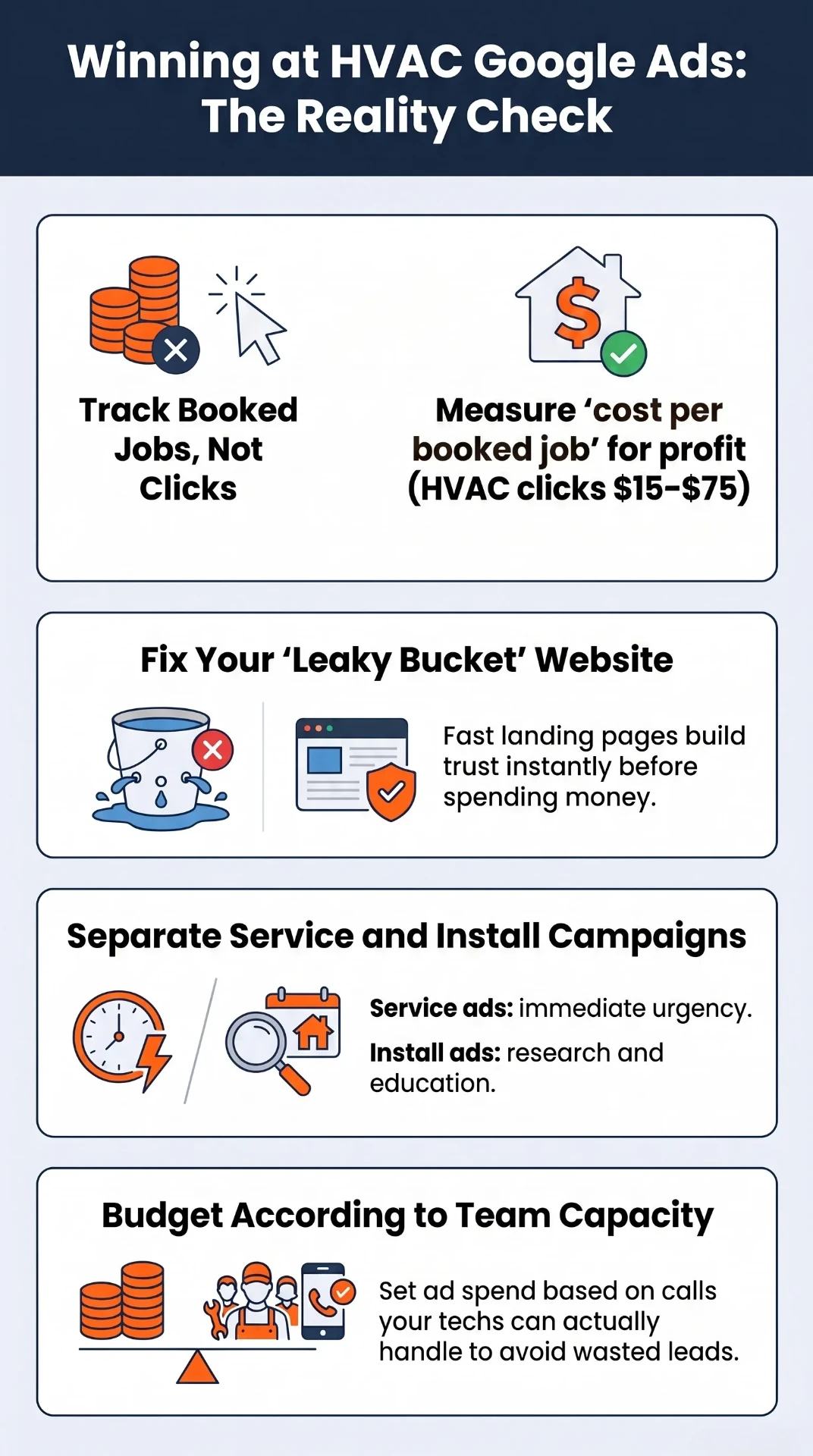
In most HVAC markets, a realistic cost per click on high-intent service keywords runs between $15 and $75 depending on your city.
That's per click, not per lead.
If your landing page converts at 10%, you're paying $150 to $750 for a single form fill or call. And not every call turns into a job.
Think about it.
If your average service ticket is $350 and your cost per booked job through ads is $300, you're not growing. You're renting revenue at nearly zero margin.
Math only works when you understand the full funnel: click to call, call to booked, booked to completed, completed to revenue.
This is exactly why knowing how many leads your company actually needs matters before you set an ad budget. The number isn't "as many as possible." It's the specific volume that fills your schedule without overwhelming your team or bleeding your margin.
Cost per click is a vanity metric.
Cost per booked job is the only number that matters.
If you're not tracking that, you're guessing.
Ads Don't Work Without the Foundation
Here's what we've seen.
A company launches Google Ads.
The traffic goes to their homepage.
The homepage has a generic headline, no clear call to action, and a contact form with seven fields. The ads generate clicks. The website loses visitors.
We covered this in detail in why your HVAC website isn't converting. Your ads are only as good as the page they land on.
If the messaging doesn't match what homeowners care about, they leave.
A high converting website built for conversion is the prerequisite, not the afterthought.
Let's be honest.
Your landing page needs to do three things in five seconds: confirm the visitor is in the right place, prove you're trustworthy, and make it easy to call or book.
If any of those are missing, your ad spend is subsidizing your bounce rate.
Your Google Business Profile matters here too. A homeowner clicks your ad, glances at your GBP listing, sees 30 reviews at 3.8 stars, and clicks back. Your review profile is the credibility layer that supports or undermines every ad dollar you spend.
Sending paid traffic to a weak website
is like paying to fill a bucket with holes.
Fix the bucket first.
Service Ads and Install Ads Are Different Campaigns
Now this is where it gets interesting.
We broke this down in how capacity changes your marketing strategy for service versus install.
The same principle applies to paid search and Local Services Ads. Service ads and install ads should never be lumped into the same campaign.
According to ENERGY STAR's heating and cooling guidance, nearly half of a home's energy bill goes to heating and cooling.
That means the homeowner searching for emergency AC repair and the homeowner researching a full system replacement are both high intent leads. But they're in completely different buying modes.
Service ads need to capture urgency. High intent keywords like "AC repair today" or "emergency HVAC service."
These clicks are expensive but convert fast. The customer is buying now. Your ad needs to promise speed and your operations need to deliver it.
Install ads need to capture research. Keywords like "new AC system cost" or "furnace replacement quotes." These clicks are cheaper but convert slower.
The customer is comparing.
Your ad needs to lead to an educational landing page with clear next steps for scheduling a consultation.
According to the EIA's Residential Energy Consumption Survey, heating and air conditioning account for 52% of household energy consumption. A system replacement is one of the biggest decisions a homeowner makes.
The ad that earns that click needs to respect the weight of that decision, not rush past it.
One campaign for service and install
is one budget producing two kinds of waste.
Separate them or lose margin on both.
Your Ad Budget Has to Match Your Capacity
This is the piece that agencies never talk about.
Your Google Ads budget should not be set based on what you can afford. It should be set based on what your team can handle.
Before you spend a dollar on ads, you need to know your team's true weekly capacity.
How many service calls per day?
How many install jobs per week?
What's your current utilization?
Those numbers determine the ceiling on how much demand your ads should produce.
According to ACCA's research on service agreements, recurring agreements now represent 55% of HVAC industry revenue. If your techs are already committed to maintenance work, the available slots for ad-generated leads might be smaller than you think.
Overspending on ads when your board is already full creates waiting time, rushed jobs, and the kind of customer experiences that generate bad reviews.
We see this pattern constantly.
A company cranks up ad spend during peak season, generates more calls than their CSRs can handle, loses half the leads to voicemail, and wonders why the cost per job is through the roof.
Run through the capacity planning checklist before adjusting your ad budget. Know the math first. Then spend.
The best ad campaign in the world fails
when the team behind it can't keep up.
Budget to your capacity, not your ambition.
Ads Are One Layer, Not the Whole Strategy
HARDI's distribution trends data shows steady HVAC market growth through 2025.
Demand is there.
But companies that build their entire marketing strategy around paid search are renting that demand.
The moment the budget stops, the leads stop.
Understanding how HVAC marketing actually works means understanding that ads are one layer of a broader marketing infrastructure.
Paid search captures demand that exists right now.
Organic SEO builds a base of traffic that compounds over time.
Local SEO and your GBP drive calls without a per-click cost.
Reputation multiplies the conversion rate across all of them.
We covered the question of when to run ads and when not to separately.
The short version: ads make sense when your infrastructure is ready to convert and fulfill the demand they create. Without that, you're buying traffic that goes nowhere.
According to AHRI's monthly shipment data, equipment shipment volumes fluctuate significantly month to month. Your ad strategy needs the same flexibility.
Scale up when demand softens.
Scale back when your board is full.
That's not a campaign. That's strategic planning tied to real operational data.
Where to Start
Stop measuring leads.
Start measuring cost per booked job.
If your agency can't report on that metric, they're not tracking what matters.
Audit your landing pages. Every ad should point to a dedicated page for that specific service, not your homepage. The page should load fast, have a click-to-call button, and answer the visitor's question in five seconds.
Separate your service campaigns from your install campaigns.
Different keywords, different landing pages, different budgets.
Check your capacity before setting your budget. If your team can handle 20 additional service calls per week, set your budget to produce 20 calls, not 50.
Track performance weekly, not monthly.
Real marketing analytics means knowing which campaigns produce booked jobs and which ones just produce clicks.
And remember: what homeowners actually care about is speed, clarity, and trust.
Your ads should reflect those values. Not jargon, not brand slogans, not generic promises.
Specifics that match the customer's situation.
Google Ads can absolutely work for HVAC companies.
But only when you know what to expect,
what to measure, and what to build underneath them.