Every HVAC company hits the same moment.
Business slows down. The phone stops ringing. And somebody says it.
"We need to run ads."
It sounds logical. Spend money, get leads, fill the schedule. And sometimes it works. But most of the time, for most HVAC companies, it doesn't work the way they think it will.
Not because ads are broken.
Because the business isn't ready for them.
Ads don't create demand out of thin air.
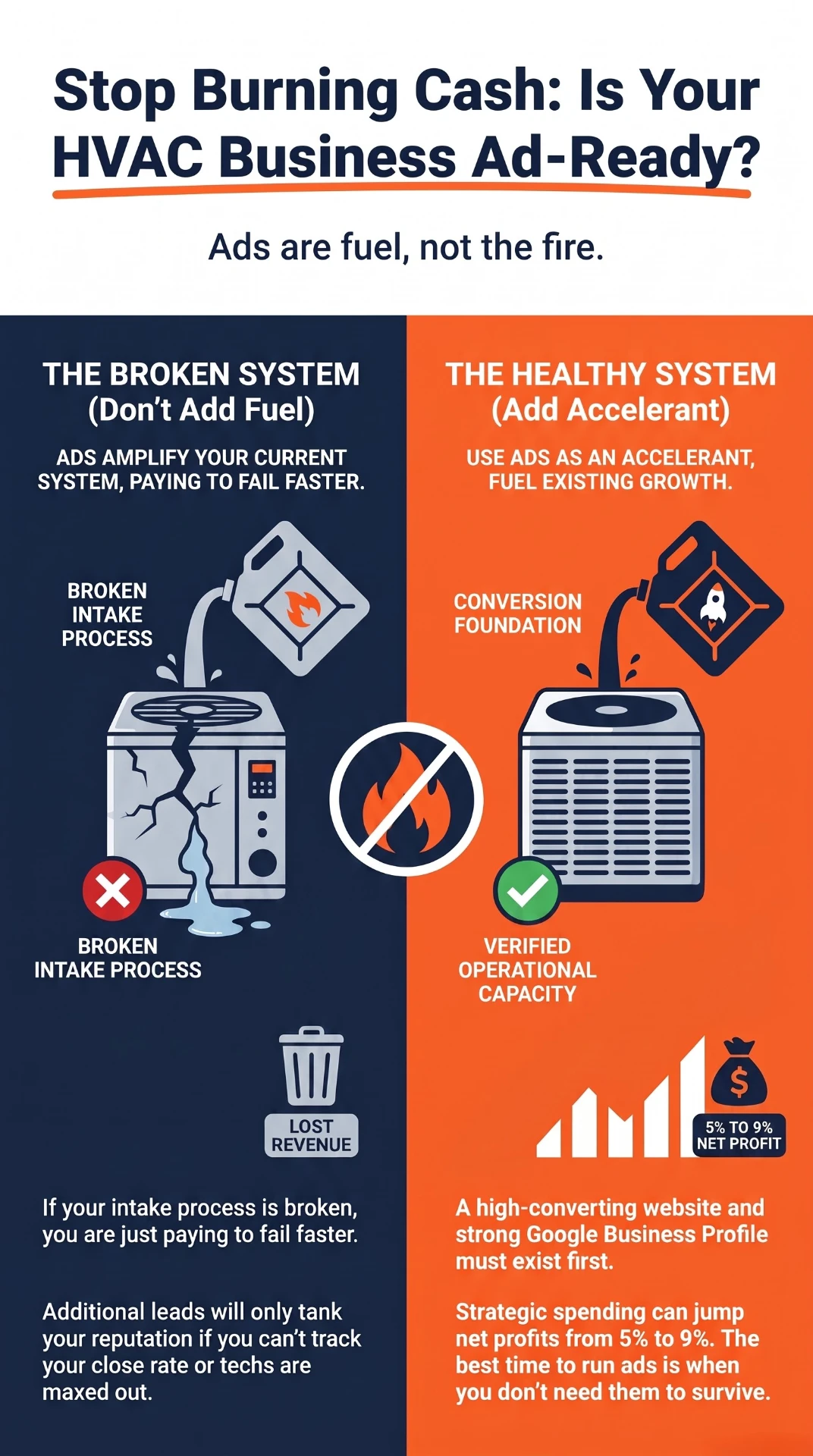
They amplify whatever system you already have. If that system is broken, you're just paying to expose the cracks faster.
Here's the thing.
The decision to run paid ads is not a marketing decision. It's an operations decision. And until HVAC owners start treating it that way, they'll keep burning money and wondering why the ROI never shows up.
The Real Problem With Running Ads Too Early
Most HVAC contractors jump to ads because it feels like action. You set a budget, pick a platform, and leads start showing up. But understanding how HVAC marketing actually works means recognizing that ads are the last step in a process, not the first.
Let's break this down.
When you run ads before the rest of your marketing system is ready, you're essentially paying to send strangers to a business that can't convert them.
The website doesn't speak to what homeowners care about. The phones aren't answered fast enough. There's no follow-up process. The techs are already overbooked or underbooked in all the wrong ways.
And those leads? They evaporate.
According to the ACCA blog on marketing budget allocation, contractors often confuse budget with strategy. The recommended approach is to invest around 10% of gross revenue in marketing, but that investment only pays off when it's tied to clear revenue targets and internal conversion rates.
Dumping money into Google Ads without that foundation is guessing. Expensive guessing.
If you can't tell me your close rate, your average ticket, or how many jobs your crew can actually run next week, you are not ready for ads.
Full stop.
When You Should Not Be Running Ads
This is where most HVAC companies get it wrong.
They think the only barrier to ads is budget. Got $2,000 a month? Run ads. But the real question isn't whether you can afford ads. It's whether your business can actually handle what they produce.
Here's what we've seen.
If you haven't done basic capacity planning, ads will either overwhelm your team or underwhelm your expectations. You need to know how many leads your HVAC company actually needs before spending a dollar on paid traffic. Otherwise, you're flying blind.
Don't run ads when:
Your website can't convert. If a homeowner lands on your site and doesn't immediately understand what you do, who you serve, and why you're credible, that click was wasted. And you still paid for it. If your HVAC website isn't converting, paid traffic just accelerates the leak.
Your Google Business Profile isn't optimized. A weak profile means weak local visibility, which means your ad spend has to work harder to compensate for ground you should have already covered with your local SEO foundation.
Your team doesn't have bandwidth. This is the one nobody wants to hear. If your techs are already running six calls a day and your install crew is booked three weeks out, more leads won't help. They'll just create chaos. Calculating your team's true weekly capacity is a prerequisite, not a nice-to-have.
The BLS Occupational Outlook Handbook projects about 40,100 HVAC technician openings per year through 2034, which tells you how tight the labor market is.
Running ads when you can't staff the work is a fast way to tank your reputation with unanswered calls and delayed appointments.
The worst thing you can do is generate demand you can't fulfill.
Every missed call, slow response, or botched handoff trains a homeowner to call your competitor next time.
Think about it.
We see this constantly in HVAC businesses. An owner turns on Google Ads, leads start coming in, and the office staff is already drowning. There's no intake process.
There's no way to differentiate a maintenance call from a full system replacement. And nobody's tracking which types of jobs the marketing should actually focus on.
That's not a lead generation problem. That's an infrastructure problem.
When Ads Actually Make Sense
Now this is where it gets interesting.
Because ads do work. When they're deployed into a system that's ready for them, paid search and local service ads can be extremely effective for HVAC companies.
But you need to earn the right to run them.
Ads make sense when you've already built the infrastructure underneath them. That means your website messaging is dialed in and built to drive booked calls.
It means your site answers the real questions homeowners are asking when they're deciding who to hire.
It means your reviews are solid, your online reputation is being actively managed, and you know how many reviews your business actually needs to compete.
According to the EIA's Residential Energy Consumption Survey, heating and cooling account for roughly 52% of a household's annual energy consumption.
Homeowners need these systems.
They need service.
The demand exists.
The question is whether your business is built to capture it when paid channels start driving traffic.
The ACCA Contractor of the Future study found that contractors allocating at least 12% of revenue to marketing see net profits jump from 5% to 9%. But that stat only holds when the spend is strategic, not reactive.
Here's what we've seen work.
Companies that run ads successfully aren't treating them as a lifeline. They're treating them as an accelerant. Their marketing infrastructure is already generating organic demand. Their SEO is working in the background. Their paid search and local service ads are layered on top, not propping everything up.
Ads should be fuel on an existing fire.
If you're using them to start the fire, you'll burn through cash before anything catches.
The Readiness Checklist Nobody Talks About
Before you spend a dollar on ads, run through this.
Do you know your team's weekly capacity? Not a rough guess. An actual number. How many service calls, how many installs, how many maintenance visits can your operation handle without quality dropping?
Do you know your close rate? If ten leads come in this week, how many become booked jobs? If you don't know that number, you can't calculate cost per acquisition. And if you can't calculate cost per acquisition, you have no idea whether your ad spend is working.
Is your website built to convert? Not just to look good. To convert. There's a difference. A site that builds trust, communicates your value, and makes it dead simple to book a call. If you're unsure, that's a problem that website design and conversion optimization solves before ad dollars enter the picture.
Are your reviews doing the heavy lifting? Homeowners check reviews before they check your ad copy. If you're running ads with a 3.8-star rating and 14 reviews, the click-through might work but the booking won't.
Can you track what's working? Without proper analytics and reporting, ad spend turns into a black box. You need to see which campaigns produce booked jobs, not just clicks.
HARDI's monthly Trends report showed distributor sales growth in the lower half of the 3.5% to 4.5% range through November 2025, with flat underlying unit demand. The market is normalizing. That makes strategic spending even more critical because there's less room for waste.
And this is exactly why most HVAC marketing fails before it starts. The foundation isn't there. The ads get the blame. But the ads were never the problem.
Timing Your Ad Spend to Your Business Reality
Let's be honest.
There's a seasonal rhythm to HVAC and pretending there isn't is a mistake. But the bigger mistake is only thinking about ads in terms of seasons.
The ACCA recommends front-loading 60% to 70% of marketing spend into peak months when customer acquisition costs are lowest. That makes sense. But only if your business is structured to absorb that volume.
Here's what most HVAC companies do instead.
They panic-spend in slow months, trying to fill a schedule that's empty because they didn't build consistent demand earlier. Then when peak season hits, they either overspend into a team that's already maxed out or pull back because they're "too busy for marketing."
Both approaches are lost.
The companies that get this right are the ones thinking about growth strategy and planning year-round. They know what their capacity looks like month by month. They adjust ad spend based on real operational data, not gut feelings. And they've already invested in the organic channels, the AI search visibility, the content, the local presence, that keep the baseline steady even when paid campaigns are dialed down.
This is why we don't start with ads. We start with structure.
Because when the structure is right, ads are a lever you can pull with confidence. You know what a lead costs. You know what it takes to close it. You know whether your team can handle more volume right now or whether you need to hold.
The best time to run ads is when you already don't need them to survive.
That's when they become a growth tool instead of a crutch.
What This Looks Like In Practice
If your schedule has consistent gaps and you don't know why, don't run ads. Fix the system first. Look at your website. Look at your intake process. Look at your follow-up. Look at your reviews.
If your schedule is reasonably full from organic and referral demand and you want to grow into a new service area or push a specific offering, that's when ads make sense. You have a baseline. You have operational capacity. You have the infrastructure to convert.
If you're somewhere in between, start with the things that compound. SEO. A strong Google Business Profile. A website that actually sells. Reviews that do the convincing for you. These are the things that make ads work when you're ready to turn them on.
Ads are not a strategy.
They're a tool inside a strategy.
And the companies that treat them that way are the ones who stop wasting money and start building something that lasts.