The phone rang. Nobody answered.
It happened at 2:14 PM on Tuesday. Your techs were on calls.
Your office manager was processing an invoice. The call went to voicemail.
The homeowner didn't leave a message. They never do.
They called the next company on the list. That company answered. That company booked the job.
A $6,000 system replacement that was yours to lose.
And you never even knew it happened.
Sound dramatic? It's not.
This happens every single day in HVAC companies across the country. And it's not a small leak. It's a flood.
A missed call isn't a missed opportunity.
It's a paid lead that you already spent money to generate, handed directly to your competitor for free.
What a Missed Call Actually Costs
Let's break this down.
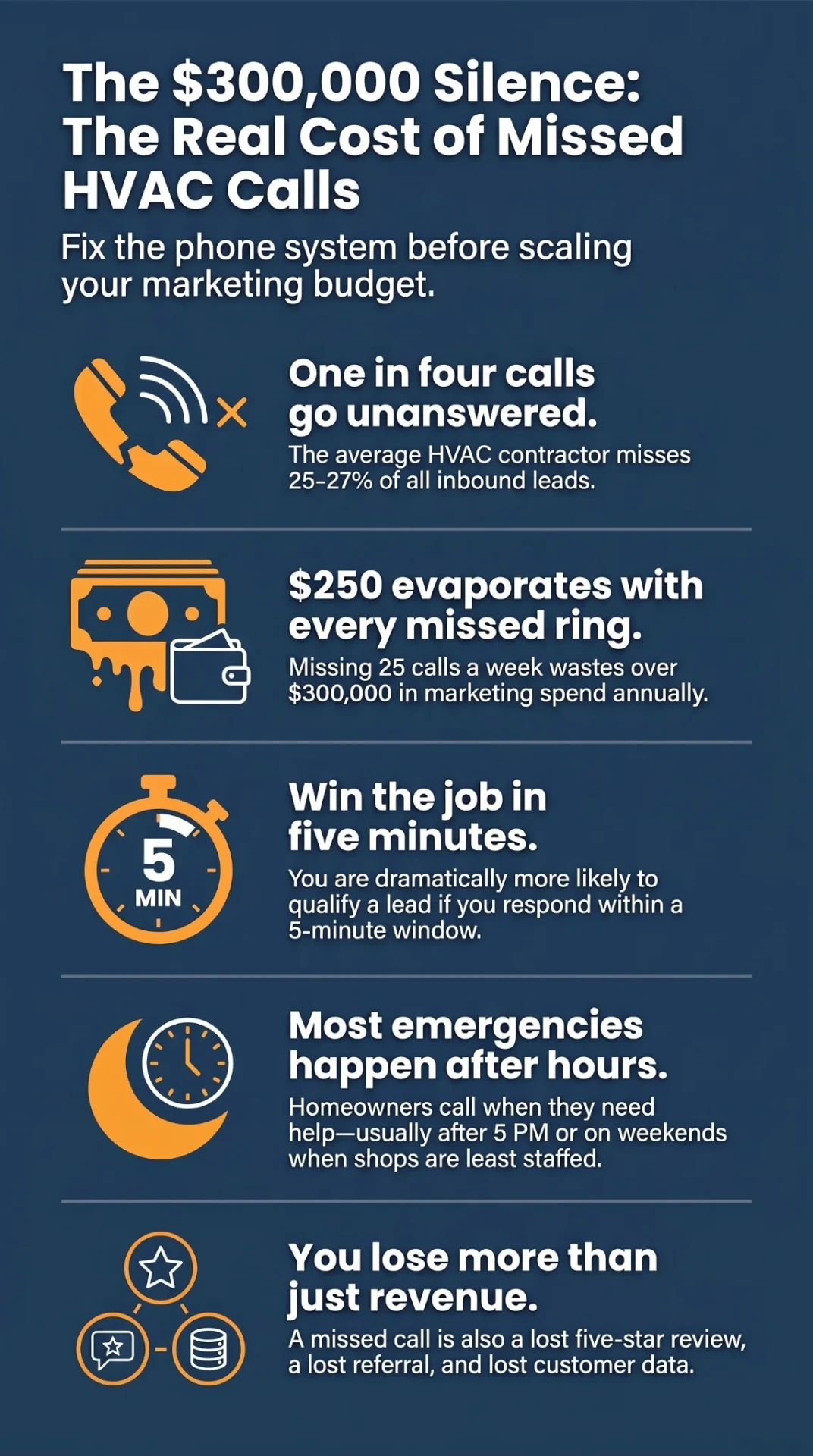
According to ACCA estimates cited across the industry, the average cost per lead for an HVAC contractor runs between $250 and $300.
That includes everything. The paid search and local service ads. The SEO investment. The website design and conversion optimization.
All the infrastructure it took to get that phone to ring.
And then nobody picked up.
That $250 just evaporated. Not because the lead was bad. Not because the marketing didn't work. Because the phone went unanswered.
Now multiply that.
Industry benchmarking data consistently shows that the average HVAC contractor misses between 25% and 27% of all inbound calls.
More than one in four. If your phone rings 100 times a week, you're missing 25 of those calls.
At $250 per lead, that's $6,250 a week in wasted marketing spend. Over $25,000 a month. Over $300,000 a year.
The ACCA blog on marketing budget allocation emphasizes that contractors should invest around 10% of gross revenue in marketing with a strategic focus on ROI.
But no amount of strategic spending matters if the leads it produces go unanswered.
Think about it.
You could have the best marketing infrastructure in your market.
Your Google Business Profile could be driving serious lead volume. Your website messaging could be dialed in to drive booked calls. And all of it gets wasted the moment nobody answers.
Your marketing worked. It got the phone to ring.
The failure happened after the ring. And that's not a marketing problem. It's an operations problem.
When Calls Get Missed and Why
Here's what we've seen.
Most HVAC companies don't miss calls because they don't care.
They miss calls because they're busy doing the work. Techs are in attics.
The office manager is juggling three things at once. Peak season hits and every line is tied up.
But homeowners don't know that. They just know nobody answered.
And here's the part that hurts.
Most homeowner calls to HVAC companies happen after 5 PM, on weekends, or during the exact hours when most shops are least staffed.
The homeowner whose AC died at 8 PM on a Saturday isn't waiting until Monday to call. They're calling now.
And they're calling however many companies it takes until someone picks up.
Research on lead response consistently shows that responding to a lead within five minutes makes you dramatically more likely to qualify that lead compared to waiting even 30 minutes.
The first contractor who answers the phone and confirms availability wins the job most of the time in emergency situations. Second place is essentially last place.
The BLS Occupational Outlook Handbook projects about 40,100 HVAC technician openings per year through 2034 with 8% employment growth.
The labor market is tight. Teams are stretched. And that means the phone coverage gap is getting worse, not better.
This is exactly why most HVAC marketing fails before it starts. Not because the strategy was wrong. Because the operational systems weren't ready to handle what the strategy produced.
The homeowner doesn't care why you didn't answer.
They just know you didn't. And by the time you call back, they've already booked with someone who did.
The Hidden Damage Beyond the Missed Job
And this is where most HVAC companies get it wrong.
They think a missed call only costs them that one job. But the damage is deeper than that.
A missed call is a missed review.
That homeowner you never served? They would have left you a five-star review that helped you build the review count your business needs to compete.
Now that review goes to your competitor.
A missed call is a missed referral. Happy customers refer. Customers you never booked don't.
A missed call is a missed data point. Without proper analytics and reporting, you don't even know how many calls you're missing.
You can't fix what you can't see.
And a missed call warps your marketing data. When leads come in and don't convert, the natural assumption is that the leads were bad.
But if 25% of them were never answered, you're blaming the ad performance or the organic visibility when the real problem was your phone.
This is why we talk about understanding how HVAC marketing works as a full system, from demand generation to a scheduled job.
If any link in that chain breaks, the whole system underperforms. And the phone is the most fragile link in most HVAC businesses.
According to the EIA's Residential Energy Consumption Survey, heating and cooling account for roughly 52% of a household's annual energy consumption.
ENERGY STAR's savings data shows the average household spends more than $2,200 a year on energy bills, with nearly half going to heating and cooling.
These are high-value decisions. Homeowners calling about a system replacement or emergency repair are ready to spend.
They're not browsing. They're buying. And every unanswered call is one of those buyers handed to your competition.
You're not just losing a job. You're losing the review, the referral, the lifetime value, and the data.
A missed call is the most expensive thing in your business that you're not tracking.
How to Stop Bleeding
Now this is where it gets interesting.
The fix for missed calls isn't complicated. But it does require treating phone coverage as part of your marketing system, not as a separate operations concern.
Here's what we've seen work.
First, know your numbers.
Pull your call log for the last 30 days.
How many inbound calls came in? How many were answered? How many went to voicemail? How many voicemails were returned within five minutes?
If you don't know these numbers, you're flying blind. And you're almost certainly losing more than you think.
This ties directly into knowing how many leads your company needs.
If you need 60 leads a month to hit your revenue target and you're generating 80 but missing 25% of them, you're only working with 60 and there's zero margin for error.
Capacity planning isn't just about technician hours. It's about whether your front office can handle the volume your marketing produces.
Second, understand what your team can handle. Calculating your team's true weekly capacity includes phone capacity, not just truck capacity.
If your CSR is also your dispatcher, your bookkeeper, and your parts orderer, missed calls aren't surprising. They're inevitable.
Third, cover the gaps. After-hours, weekends, lunch breaks, peak volume periods.
These are the moments when most calls get missed.
Whether that means a dedicated answering service, an automated text-back system, or restructuring your front office, the goal is the same.
Every call gets answered or acknowledged within 60 seconds.
Fourth, train the people who answer. Answering the phone is half the battle. The other half is booking the call.
What homeowners look for when hiring an HVAC company matters in the first 60 seconds of a phone call just as much as it matters on your website.
Confidence, competence, empathy. That's what books the job.
And fifth, make sure the rest of the system supports the phone.
If your website isn't converting visitors into callers in the first place, fixing the phone only solves half the problem.
Your local SEO and Google Business Profile need to be driving the calls. Your reputation management needs to build trust that makes someone pick up the phone.
Your AI search presence needs to keep you visible as search evolves.
The ACCA Contractor of the Future study found that contractors allocating at least 12% of revenue to marketing see net profits jump from 5% to 9%.
But that return only materializes when the leads those dollars produce get answered, qualified, and booked.
The most expensive marketing strategy is the one that works perfectly up until the phone rings.
After that, it's on you.
The Real Takeaway
Missed calls aren't a minor inefficiency. They're the single biggest revenue leak in most HVAC businesses. And they're invisible unless you're actively measuring them.
Before you increase your ad spending, before you switch agencies, before you blame lead quality, pull your call data. If more than 10% of your inbound calls are going unanswered, that's your first fix.
Because leads don't matter if they don't book. And they can't book if nobody answers the phone.
Knowing when to run ads and how service versus install work shapes your marketing are important. But none of it matters if the phone rings and nobody's there.
This is why growth strategy and planning must account for every step of the chain. Not just the leads. The answer. The booking. The job. The review.
Fix the phone. Then scale the marketing.
In that order.