The marketing worked. The phone rang.
And then what?
In most HVAC companies, this is where the revenue leaks.
Not because the leads were bad. Not because the ads underperformed.
But because the person who answered the phone didn't have a system for turning that call into a booked job.
Or worse, nobody answered at all.
Here's the thing.
We've talked about the cost of missed calls and why leads don't matter if they don't book.
But knowing there's a problem isn't the same as fixing it.
What most HVAC companies need isn't more awareness. It's a repeatable process that their team can follow on every single call.
That's what this is.
A call handling checklist isn't a script. It's a framework.
It's the difference between hoping your team books the job and knowing they will.
Why Call Handling Is a Marketing Problem
Let's break this down.
Most HVAC companies separate marketing from operations.
Marketing generates leads.
Operations handle them.
But understanding how HVAC marketing works means seeing the full chain.
From the moment a homeowner searches for HVAC service to the moment a tech shows up at their door, every step is part of the same system.
The phone is the handoff point. And it's where most systems break.
The ACCA Contractor of the Future study surveyed more than 1,000 contractors and found that the average HVAC contractor closes 43% of installation quotes.
Residential contractors average 45%.
But contractors who present four or more options see close rates jump from 42% to 52%.
And contractors who always offer financing close at nearly 50% versus 38% for those who don't.
Those numbers are about the sales process.
But the sales process starts on the phone. If the call isn't handled well, the homeowner never gets to the proposal stage.
According to the ACCA blog on marketing budget allocation, contractors should invest around 10% of gross revenue in marketing.
That's real money. And every dollar of that investment rides on what happens when the phone rings.
This is why most HVAC marketing fails before it starts. The marketing works. The conversion doesn't.
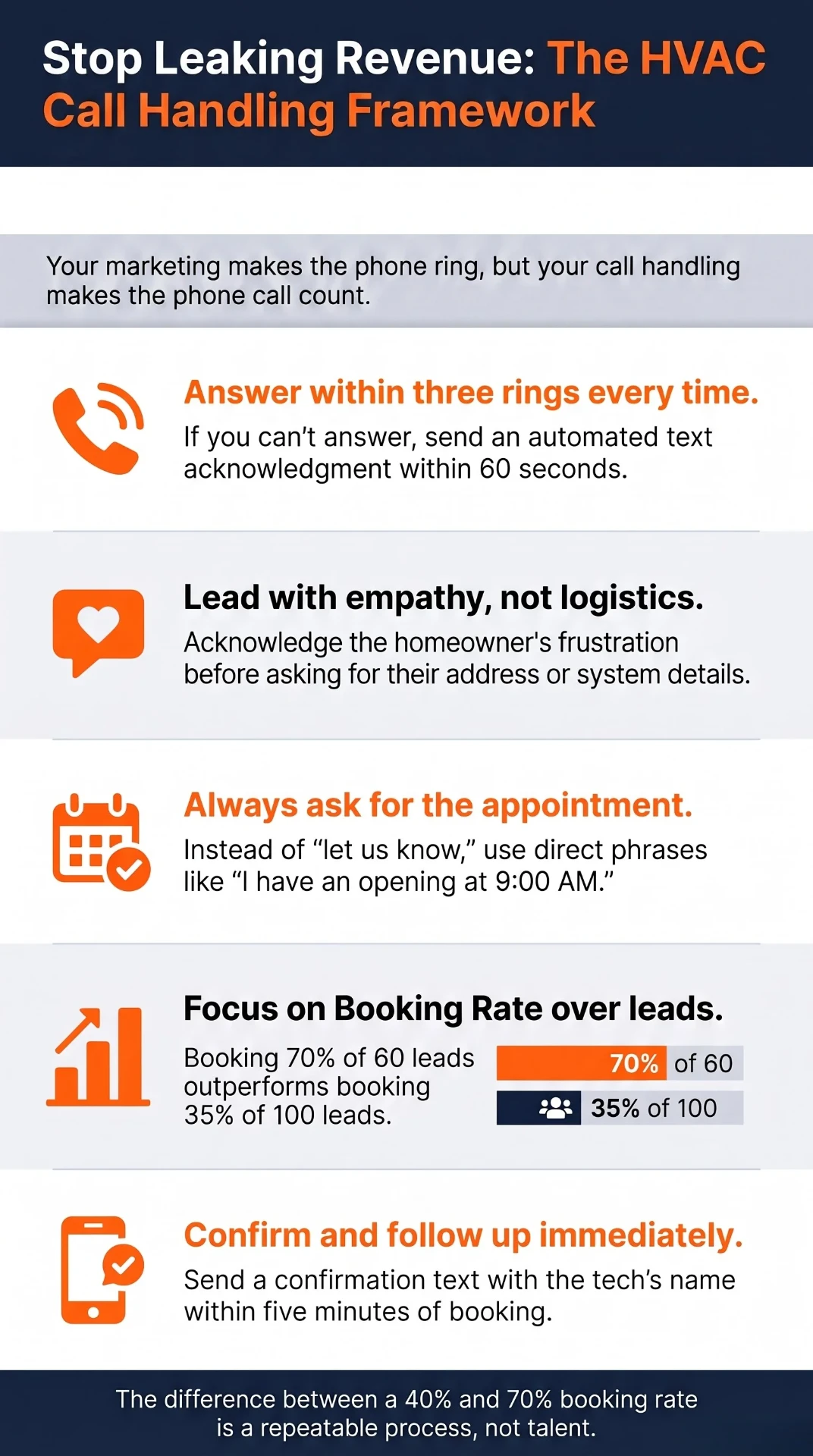
Your marketing's job is to make the phone ring.
Your call handling's job is to make the phone call count.
The Call Handling Checklist
Here's what we've seen work.
This isn't a rigid script.
It's a framework that adapts to every call while making sure nothing critical gets missed.
The best HVAC companies we work with treat this like a process, not a suggestion.
Answer within three rings.
Every time. If you can't answer, an automated text acknowledgment should fire within 60 seconds telling the homeowner you saw their call and will be right back with them.
The fastest company to respond wins the job in emergency situations most of the time. Second place is last place.
Lead with empathy, not logistics.
The homeowner calling about a dead AC in August doesn't want to hear "what's your address?" first.
They want to hear "I understand how frustrating that is, let's get this handled for you."
Acknowledgment before information. Always.
This ties directly to what homeowners look for when hiring an HVAC company.
Trust. Competence. Responsiveness.
Those signals start on the phone, not on the website.
Qualify the call.
Ask the right questions.
Is this a repair, maintenance, or replacement?
How old is the system?
When did the issue start?
Is anyone in the home who's vulnerable to extreme temperatures?
This isn't interrogation. It's demonstrating competence and gathering the information your tech needs to show up prepared.
Know your availability.
If the person answering the phone must put someone on hold to check the schedule, you've introduced friction.
Calculating your team's true weekly capacity means your front office knows exactly what's open, what type of work fits where, and how service versus install jobs change the available slots.
Set expectations clearly.
Tell the homeowner exactly what happens next. When the tech will arrive.
What the diagnostic process looks like.
What they should expect on cost.
Ambiguity kills bookings. Clarity creates them.
Ask for the appointment.
This sounds obvious, but it's the most missed step.
The call goes well, the homeowner gets their questions answered, and then the conversation drifts toward "well, let us know if you'd like to schedule." No. Ask. "I have an opening tomorrow morning at 9. Can I get you scheduled?" Direct. Clear. Confident.
Confirm and follow up.
Send a confirmation text or email within five minutes of booking.
Include the tech's name if possible.
Include a reminder the morning of the appointment.
This reduces no-shows and reinforces that the homeowner made the right choice.
The difference between a 40% booking rate and a 70% booking rate isn't talent.
It's process. And process can be taught, measured, and improved.
What Happens Before the Phone Rings Matters Too
Now this is where it gets interesting.
The call doesn't start when the phone rings. It starts when the homeowner first encounters your business.
If your website isn't converting, fewer people pick up the phone in the first place.
And the ones who do call are less confident, less informed, and harder to book.
Strong website messaging that drives booked calls pre-qualifies the caller.
By the time they dial, they already know what you do, who you serve, and why you're credible.
Your Google Business Profile is doing the same work.
A complete profile with strong reviews, optimized through proper local SEO, gives the homeowner confidence before they ever hear a voice.
And having enough reviews isn't vanity. It's pre-call persuasion.
Active reputation management compounds this effect over time.
Every five-star review makes the next phone call easier to book because the homeowner has already decided you're credible before they dial.
And your broader organic presence matters.
If your ads are running without organic visibility backing them up, the homeowner who clicks your ad and then Googles your company name finds nothing.
That uncertainty carries into the phone call. But when your SEO is working and your AI search presence is keeping you visible, the caller shows up pre-sold.
According to the EIA's Residential Energy Consumption Survey, heating and cooling account for roughly 52% of a household's annual energy consumption.
ENERGY STAR's savings data shows the average household spends more than $2,200 a year on energy bills, with nearly half going to heating and cooling.
These are significant decisions. And the homeowner's confidence when they pick up the phone is directly shaped by everything they encountered before dialing.
The best call handlers don't close calls. They finish a process that started long before the phone rang.
Website, reviews, profile, presence. Then the phone. That's the system.
Measuring What Matters
And this is where most HVAC companies get it wrong.
They track cost per lead.
They track ad impressions.
They track website traffic.
But they don't track the one metric that tells them whether any of it is working: booking rate.
Booking rate is the percentage of inbound calls that become scheduled appointments. If you're not tracking it, you're flying blind.
Without proper analytics and reporting, you can't tell whether your call handling is the problem or your lead quality is.
You can't tell which CSR is booking at 65% and which one is at 35%. You can't tell whether the after-hours calls are converting or dying.
And you can't make informed decisions about when to run ads or what to expect from Google Ads if you don't know what's happening after the click.
The BLS Occupational Outlook Handbook projects about 40,100 HVAC technician openings per year through 2034 with 8% employment growth.
With a tight labor market and rising costs, the margin for waste is shrinking. Every missed booking is more expensive than it was last year.
HARDI's monthly Trends report showed distributor sales growth in the lower half of the 3.5% to 4.5% range through late 2025, with flat underlying unit demand.
In a normalizing market, squeezing more bookings from the same lead volume is the fastest path to growth.
Knowing how many leads your company needs is important.
But knowing how many of those leads your team converts is more important.
Because a company that needs 60 leads and books 70% of them is outperforming a company that generates 100 leads and books 35%.
This is what capacity planning looks like in practice. Not just technician hours. Phone hours. Front office hours. The operational capacity to convert what marketing produces.
You can't improve what you don't measure.
And the most important number in your marketing isn't cost per lead. It's booking rate.
The Real Takeaway
Your phone is not a utility. It's a conversion tool. And like any conversion tool, it needs a process, training, and measurement.
The checklist is straightforward.
Answer fast. Lead with empathy. Qualify the call. Know your availability. Set clear expectations. Ask for the appointment. Confirm and follow up.
None of this is complicated. But doing it consistently, on every call, with every CSR, during every season? That's where most companies fall apart.
This is why we treat call handling as part of the marketing infrastructure, not separate from it. The phone is where the investment pays off. Or doesn't.
Strong website design and conversion optimization gets the visitor to call.
Paid search and local service ads put you in front of the right people.
But the booking happens on the phone. And a real growth strategy accounts for every step.
Fix the call handling. Then watch the same marketing spend produce twice the results.
That's not theory. That's math.